


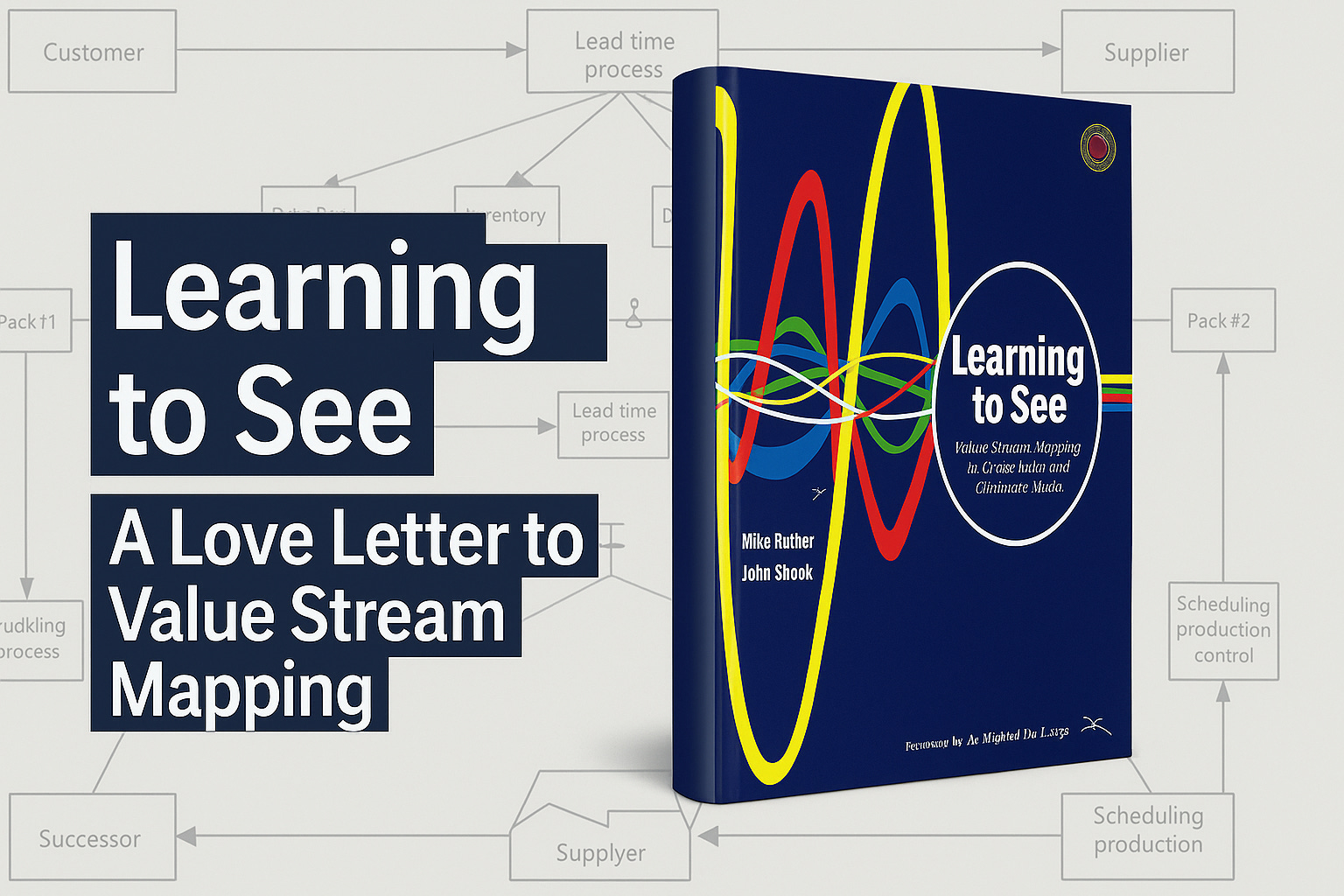
This is a love letter to a tool, a philosophy, and a way of perceiving the world that changed everything for me. Learning to See is a book about reclaiming clarity.
The Illusion of Metrics
If you’ve been in operations long enough, you know the scene: a room full of managers gathered, each having written their prior-day numbers on the board for the morning meeting. If the numbers are green, they exhale and tune out. If the number is red, they await the moment the attention turns to them. It begins. Almost in staccato.
“Have you identified the root cause?”
“When will you have countermeasures?”
“Who owns this and when will it be done?”
There usually is a flurry of words, action boards updated, and a promise is demanded to report back. The next meeting, the metric could be back to green again. Or still red, which leads to the same discussion, only louder and with a dash of “escalation.”
It’s a ritual. A war room of well-intentioned people managing symptoms using summarized data, taken from the system but not directly indicative of its health. Just a series of snapshots used to represent the movie.
Most leaders don’t understand how and why those numbers turn green in the first place. Conceptually, they get how the system flows but not how it works together. In truth, most managers know how to react to a signal, but not how to interpret it. They were promoted because they were strong in their function, but during the onboarding nobody taught them how the whole system works.
And now, they lead from dashboards instead of from the floor.
They walk the floor, on schedule, to be seen performing the act of leadership, then they spend the rest of the day updating spreadsheets, or in meetings. They mistake the the map of numbers for the territory where the work is done, the data for the truth. The dashboards are green, but the system is a gray box to mostly everyone.
That’s the dirty secret of most operations today. Everyone’s managing data. Who is managing the interdependent patterns and flows of interactions within the system? Those only are visible when you stop looking at the parts.
The Disconnect
It’s not malice or incompetence, just conditioning. Nobody ever taught them how to truly see.
They were trained to manage results, not complex relationships between processes. “That’s for the engineers!,” they retort. Most leaders can recite throughput and cost-per-unit, but they can’t tell you how information moves across the operation, how delays in one line cascade into others, or how waste accumulates unseen until it stops everything.
And that’s not their fault. Their leadership never gave them the tools to even begin to understand how the floor works in total, from one side through the other.
Most leadership teams are an organization full of good people, futzing around in silos, making local adjustments and causing global messes up or downstream doing actions without context. Everyone tweaks their piece, but no one understands the flow. It’s optimization without observation. Leadership without sight.
Learning to See (Again)
There’s a way out of this blindness. A simple, elegant discipline that reconnects leaders with the truth of their own operations. It’s called the Value Stream Map, and the book that introduced it to most of us — Mike Rother and John Shook’s Learning to See — remains one of the most quietly transformative texts in business.
Published in 1999, Learning to See was the first time Toyota’s internal process-mapping method was codified for the rest of the world. It teaches you how to trace the flow of value from customer request to delivery. Not as you imagine it works, but as it actually does. It reveals the terrain of your organization in a way dashboards never can show.
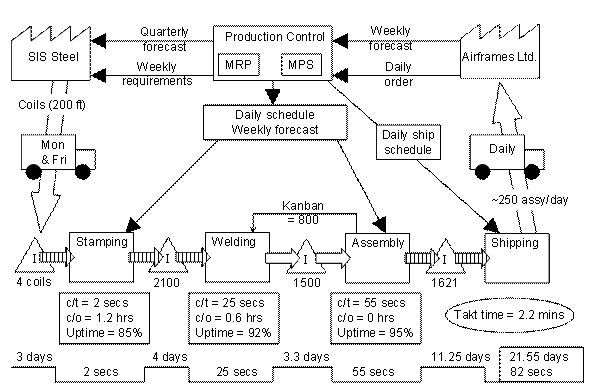
A value stream map isn’t a process diagram. It’s an x-ray. It exposes the arteries and nerves of your system — material, information, timing, handoffs, bottlenecks — all in one picture. It’s the closest thing to standing inside your business with the lights fully on, lines fully staffed and running at nominal speed.
The book’s title wasn’t metaphorical. It was an invitation. Learning to See teaches you to view the system with new eyes, as if seeing it for the first time. It helps you make the invisible visible by taking you into the interrelations between silos. And once you see, you can’t unsee.
The Gift of Seeing
I’ve said before that Learning to See changed how I lead. What I don’t often say is that “learning to see” also saved my life — long before I ever read the book.
For me, vision wasn’t only about eyesight. It was a tool of survival. As a child, my nervous system protected me by allowing me to see and read all types of patterns; emotional, relational, environmental; faster than anyone else in the room.
I didn’t learn to see as a leadership skill. I learned it as a self-preservation technique during a chaotic childhood. My body decided that clear seeing was protection, and it built a mind wired to notice everything in a system and how it works together.
That same wiring would later become my greatest gift — the ability to perceive systems, to sense where things connect, and to understand when they don’t.

But the irony is, my physical vision failed me. Many eye surgeries, long recoveries. Years of fighting for the simple act of sight.
Those experiences taught me something that transcends the literal: clarity isn’t just a condition of the eyes; it’s a condition of the soul.
Clarity is what happens when observation meets understanding. It’s the alignment between what you see and what is real. It’s the moment when you stop reacting to signals and start perceiving the kinetic pulse and movement of the system in its entirety. It’s halts. It’s limits.
That’s why Learning to See struck me so deeply. Because most organizations, and most leaders, are living with damaged vision, too. Their field of view has narrowed. Their depth perception is gone. They’ve learned to stare at dashboards instead of knowing systems, to scan for red and green instead of seeing the flow. Their entire culture is one of optical illusion. Performance theater dangerously posing as insight.
When I talk about learning to see, I don’t mean adding another metric. I am speaking of restoring clarity — in the truest, most human sense. The ability to look at your work and actually perceive it as it is. To notice cause and effect, variation and rhythm, interdependence and imbalance.
Clarity is grace made visible. It’s not perfection; it’s alignment. It’s when the noise quiets just enough for you to see truth move through the system in clear, simple, unmistakable ways.
Value Stream Mapping, at its heart, is a tool for clarity. It lets you trace every nerve of your organization, every pulse of value and waste, until the picture emerges. It’s not about documentation. It’s about illumination of how materials, efforts, information, waste and WIP (among others) move. When leaders map a value stream, they are learning to see. Not as managers of metrics, but as stewards of the system the are able to collaboratively direct.
My childhood taught me that seeing is sacred. My career taught me that clarity is how we turn survival into wisdom.
And that’s the divine act behind Learning to See. It’s the practice of returning to vision. Rediscovering how to look at what’s right in front of us until understanding begins.
Why This Matters
Most leaders aren’t blind because they don’t care. They’re blind because the system they inherited never gave them the ability to see. Dashboards replaced floor walks. Targets replaced teaching. Urgency replaced curiosity.
The VSM restores all three.
It gets you back on the floor, physically or metaphorically, to reconnect with how value really moves. It unites silos into a shared understanding of flow and shows the quirky overlaps. And perhaps most importantly, it gives you permission to learn your own system again without losing face.
A VSM isn’t about ignorance or courage. It’s about respect for the people who live inside the process every day, and for the truth of how work really flows.
The Invitation
I want to be the Johnny Appleseed of Value Stream Mapping. I want to plant this tool in every company that’s lost its ability to see.
So here’s my offer, open and unconditional. If you’ve never built a value stream map, if you’re intrigued but intimidated, or if you’ve tried before and it went nowhere: reach out. No consulting pitch, no invoice. Just a conversation.

Because the moment you learn to see your system clearly, everything changes. You stop fighting fires and start improving flow. Toyota teaches that if the system isn’t flowing properly, the leaders of the organization are disrespecting the workers. If you seek to be a manager of influence and value to your company, stop accepting reds and greens as the mark of system health.
Learn to see and you’ll rediscover the thing every great leader, every great human system, is built on: clarity.
Sources & Footnotes
Rother, Mike & Shook, John. Learning to See: Value Stream Mapping to Add Value and Eliminate Muda. Lean Enterprise Institute, 1999.
Lean Enterprise Institute. “Value Stream Mapping Overview.” Explains VSM as a comprehensive view of value creation from order to delivery, highlighting both material and information flow.
NIST MEP. “Value Stream Mapping.” Emphasizes VSM’s role in connecting cross-functional teams and aligning improvement efforts to a unified future state.
Graban, Mark. Lean Blog: Red/Green Analysis. Critiques red-green dashboard thinking and the failure to interpret green metrics as “safe.”
Flight Safety Foundation. “Normalization of Deviance.” AeroSafety World. Discusses how repeated tolerance of deviations leads to systemic failure.
Deming, W. Edwards. Out of the Crisis. MIT Press, 1982. Advocates for systems thinking, process understanding, and respect for people as the foundation of quality.
Author’s Note
I’ve spent my life trying to understand why systems fail and how people survive them. As a child, my safety depended on seeing patterns; as an adult, my purpose depends on helping others see theirs.
This essay isn’t about metrics or management. It’s about the moral act of paying attention.
If we can learn to see clearly — not just our work, but the systems we build and the people inside them — we can begin to repair both.
That’s the work. That’s the gift. And I’m grateful every day for the chance to keep learning how.
— Todd Andrew Owings
Part of the Seeing Systems Clearly series
Essays on leadership, culture, and operational wisdom — where clarity meets courage.