


Several years ago, I left a company that was a terrible fit. I was keenly certain the next role must be different, but unable to define what “different” actually meant.
This is not a story about that company. It is about the debrief: how I figured out what had happened, how I finally understand what I was searching for, and how I avoided repeating the experience elsewhere.
Eager to find a system that could help me recalibrate, I purchased an online Life Mapping exercise developed and facilitated by former advertising executives. The technique was deceptively simple.
Draw a timeline across the bottom of a page: one month, six months, a year, three and five. On the other axis, list work, family, goals, and major life moments. Then imagine yourself as you seek to exist and place the milestones that would lead you there. Do it as many times as you want until you create your ideal future!
Image you want to become a VP. You look through that lens, identify the skills and experiences the role required, place them along the timeline, and look for gaps or conflicts. So, if your goals included both becoming that vice president and owning a vacation home, for example, the need for an MBA might conflict due to cash flow. Or you could add a period where you moonlight, I suppose. The storyboard allowed you to see those collisions and adjust the sequence before living through them.
The exercise did not yield clarity for me. Not necessarily because it was flawed. My vantage point was.
I realized, while designing my ideal future, that a lifetime of unresolved trauma meant I was trying to fashion a grand plan while deafening system sirens wailed in the background. I could place precise milestones on a page, but I could not yet imagine a future outside the patterns that had shaped me.
I was asking the person formed by the system to design a life beyond it without first making the system visible. That storyboard was beyond my imagination, so I abandoned the effort and focused on healing first.
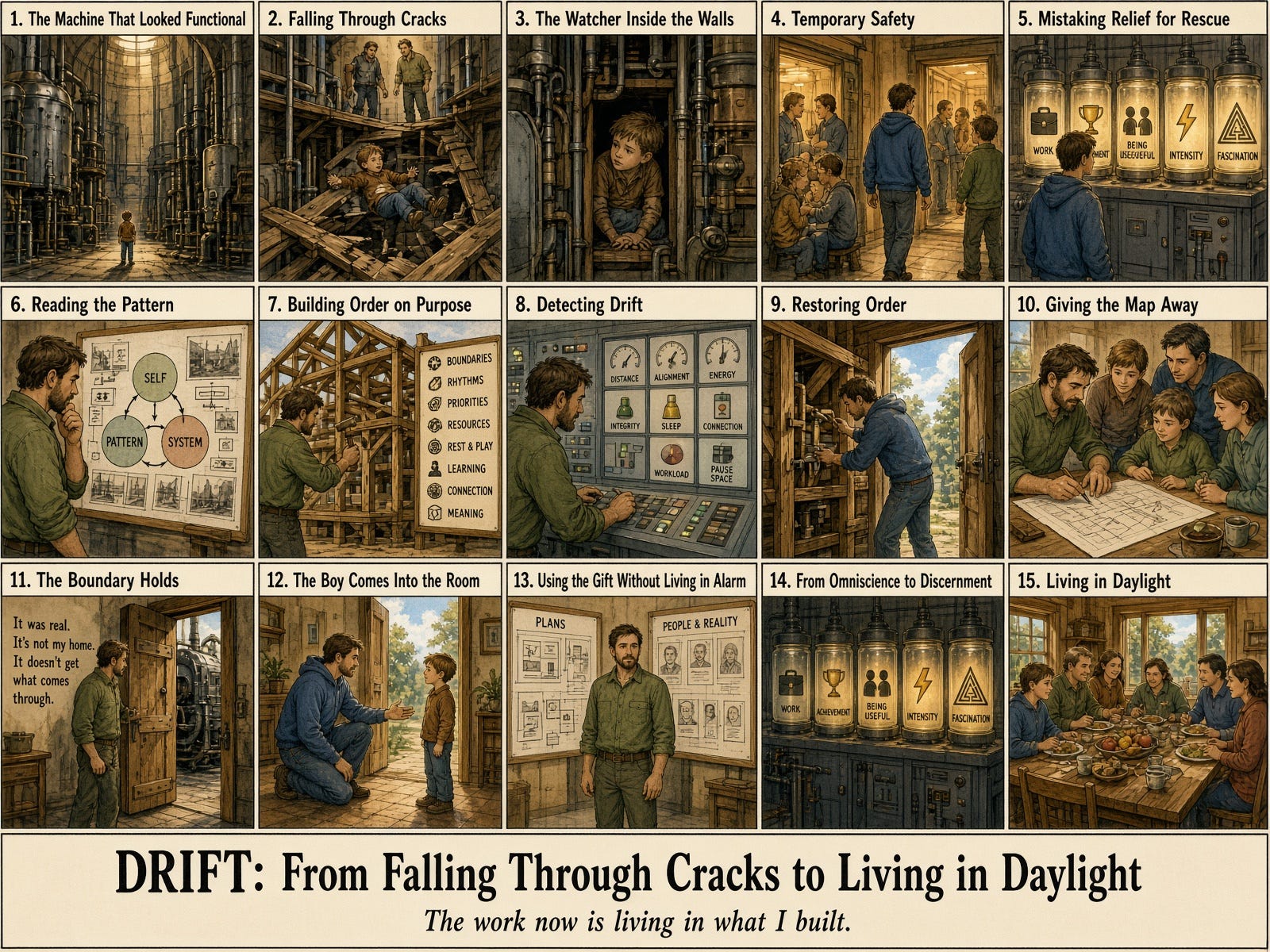
A couple of years later, the image above came to me.
This time, instead of building forward from an imagined future, I built backward from lived experience. I reverse-engineered what healing now revealed. In doing so, I saw the patterns that kept me trapped in a loop.
The image is not a summary of my life. It is a diagnostic of a single organizing pattern across many settings: how a neglected child learned to quietly observe, read the system, and make himself useful; how that adaptation became valuable; how temporary relief could be mistaken for rescue; and how the same capacity could eventually be used without continuing to live in alarm.
That is the method:
Map the pattern, not just the events.
A conventional timeline asks: What comes next?
A pattern storyboard asks: What pattern kept repeating? What did it require me to become—or conceal? Where did that response protect me? Where was it rewarded? Where did it begin to cost me? What useful capacity remains once the alarm is removed?
To make one, choose a recurring adaptation rather than trying to explain your entire life. It might be being small and staying invisible, or becoming useful to others, or anticipating danger, rescuing others, achieving recognition, controlling, pleasing, or withdrawing.
Understand the way the pattern operates today. Then, trace it backward to the conditions that first made it necessary. Follow it forward through the places where it repeated. The point is not perfect chronology. The point is to make the hidden structure visible.
Create eight to fifteen panels. Each panel needs only to capture a situation or period and name what was happening underneath. The panels can use words, sketches, photographs, collages, or generated scenes. Clarity matters more than artistry.
The work depends on honesty. Be open, exact, and unfiltered. Do not lie to yourself. Across the sequence, look for five things:
The original condition
The adaptation it produced
The temporary relief that kept it alive
The recurring cost
The useful capacity that remains when the alarm is removed
Do not force the map into a redemption story. Accuracy matters more than inspiration. What emerges is more than a record of the past. It is the forest made visible to someone who has spent years among the trees.
You begin to separate identity from adaptation. The map does not tell you who you are. It shows you what you learned to do in order to adapt and function. You may begin to see how different jobs, relationships, ambitions, and crises were expressions of the same underlying structure. You’ll see both the gift and the cost without allowing either one to erase the other.
Most importantly, the map creates distance.
Once the pattern is outside of you, you no longer have to rely only on memory, explanation, or alarm to understand it. You can see the system as a whole. It becomes a living reference document.
And once you can see the system, you can choose what to keep, what to repair, and what to stop carrying.
-30-
The storyboard was a real way to see the work I've done. If you read this and any of it resonates, reach out. I'll be glad to offer any support in building your own life cartoon strip. For those who need data to believe it's done, this is exactly that for me.