


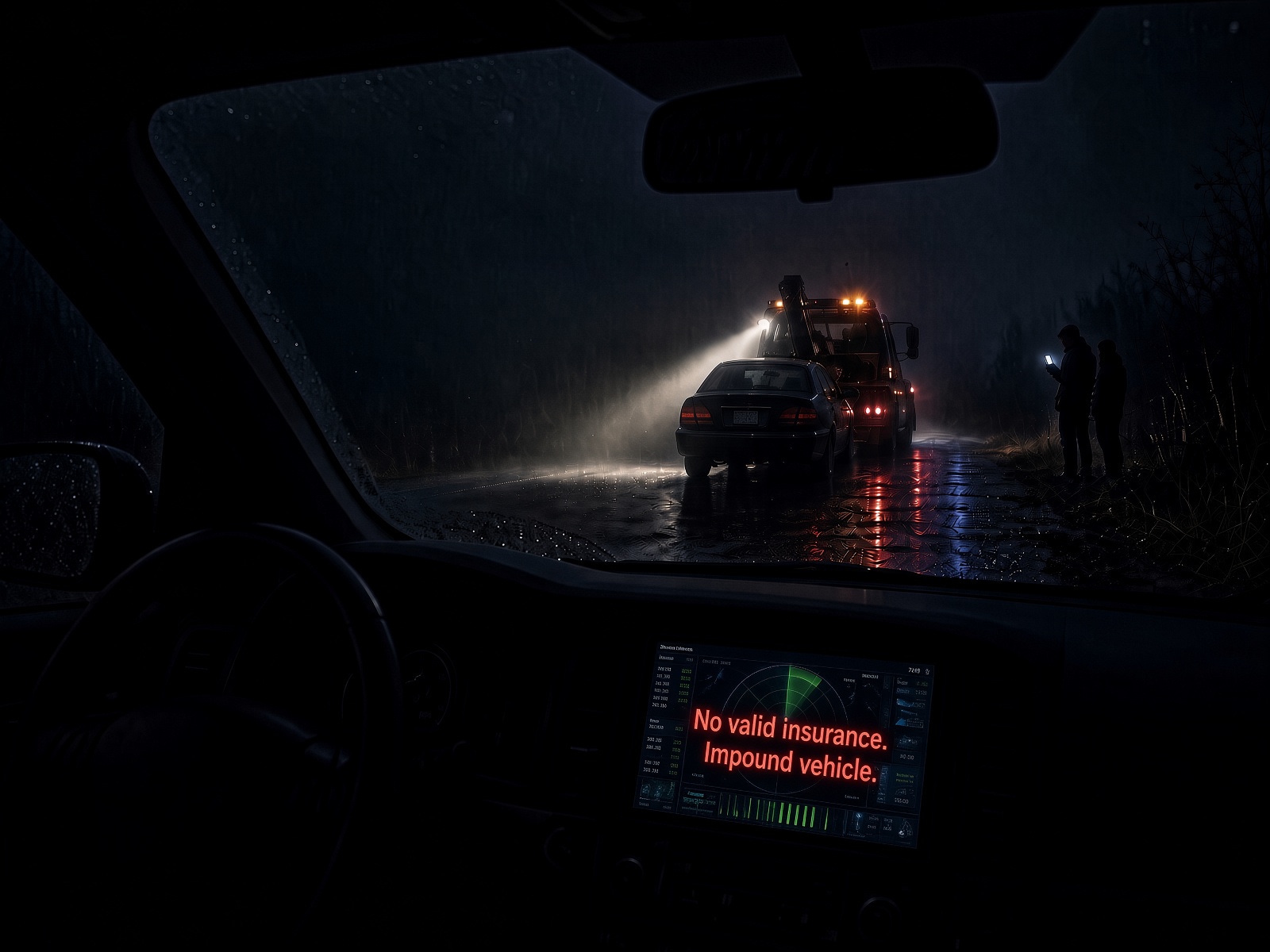
The tow truck was enroute regardless of the evidence.
It was late April of this year, in Georgia, around 2:30 in the morning. A 71-year-old retired Army veteran was driving home with her husband, a 75-year-old amputee who hadn’t walked in two years. They drove past a police cruiser with an automated license plate reader onboard. The database immediately tagged the vehicle as uninsured. A traffic stop ensued.
When the police office approached the vehicle, he explained that the vehicle showed up as uninsured and could not be operated legally until it was insured in the system. The driver, who had active insurance coverage through USAA, tried to show proof of insurance on her phone and through her vehicle registration. Later, USAA confirmed the policy was active at the time of the stop. The state’s database was wrong.
But on the roadside, it was an unstoppable process underway. The officer explained that a tow truck was coming. When the woman pushed back with valid papers in hand, the officer explained he must follow what the state and the system declared. The vehicle was towed. The couple left on the side of the road around 3 a.m.
I think about that moment. How it could be me. You. Anyone.
The officer made a bad call, the human result was awful. But I keep thinking about it because it demonstrates something larger. The system had achieved administrative completion and was satisfied. Human completion was out of scope in that transaction.
Administrative completion is the new standard. It happens when the record closes, a scan clears, a code triggers or a ticket is issued. The tow is called. The work order disappears. The transaction reaches the point where the system declares it done.
But completion on paper is not completion in life.
Human completion means the reality on the ground is made whole. The person is safe. The evidence was considered. The damage repaired or responsibility assigned. The remaining work not pushed onto someone simply because they possess less authority and fewer options.
Modern systems are excellent at closing loops inside their own records. They are far less reliable at closing the loop for the person left standing on the side of the road as their car is towed away.
I keep seeing the phenomenon play out everywhere.
We ordered a large house fan item from Amazon. When the box arrived, one side was crushed inward and the cardboard torn open. There was missing Styrofoam visible. The fan itself still was wrapped in plastic, but the packaging told of a rough journey though the supply chain. Somewhere along the chain, the box was damaged and nobody stopped it.
Upon seeking to return the item, the seller’s first response was that the product was fine and we should keep it. Then a restocking fee appeared. After days of back-and-forth, they finally agreed to take it without the fee. That work out of the way, I had to tape the torn up box and take it to the UPS Store. For Amazon, the delivery scan had closed the transaction. Everything required to make the outcome whole again was left for the customer to invent and perform.
A utility crew hired by a national telecommunication carrier buried fiber across the back of our property early in the spring. When they finished, large patches of grass were destroyed. The technical work was marked complete. When I tried to get the damage addressed, the city claimed no jurisdiction, the contractor pointed to the carrier, and the carrier pointed back to the contractor.
No one owns the residual impact. Insurance does not cover it. Suing isn’t realistic. Everyone involved moved on. The problem was only mine.
In each case, the pattern is the same. The system closes on its own internal signal. Database flag. Delivery scan. Whatever. Once that signal is hit, any human need remaining is considered outside the process. The residual damage of a system ignoring the people impacted by it does not disappear. Those impacts are simply reassigned to the person left to clean up the mess from it.
I hear the same logic on the factory and warehouse floor.
A reasonable request to print labels next to where they are used, so people stop walking extra steps, is met with a familiar sentence:
“The system won’t let us do that.”
The sentence does two big things at once. It declares the current system boundary as fixed, and it makes the person asking for the improvement feel as if they are the one being unreasonable. The system is treated as the final authority. Local judgment and the actual needs of the work become secondary. The extra movement stays with the people closest to the process.
People on both sides of these transactions can often sense the wrongness. The officer probably believed the insurance card was correct. The agent probably knew the box should not be delivered in that condition. The contractor knew the yard should be restored. The supervisor senses that walking labels across the building is waste.
But the system inverted the risk.
Acting on human knowledge is as risky, or riskier, than simply following the administrative path. Discretion becomes a form of liability. Fair judgment of a situation exposes one to risk. The safer move, for almost everyone involved, is to complete the required system step and walk away.
The person left holding the broken result is granted full agency to care. But the system measured a successful compliance, and moved on. That is what “our system can’t do that” now means.
It announces the transfer. The system is finished according to its definition. The human need has been cut out. The residual work now reassigned. The person who did not design the system is the one left to carry what it no longer accounts for.
This is one way Drift enters ordinary life. A thousand tiny transfers of unfinished work from the system to those unable to reassign it to others. A process that creates extra steps because no one with authority has to walk them day after day.
The system still runs because people have little choice but to keep absorbing what it refuses to hold. The nature of being a customer of the system is what has changed most.
Where are you carrying work the system has already declared finished?
-30-
Author’s Note
This piece is part of a larger body of work I am developing around Drift.
Drift is the slow movement of a system away from it’s designed or natural purpose. One of the main symptoms of drift is when a system declares work completed while leaving a person to carry what remains.
This article isn’t about the example I gave. It’s the pattern underneath that interests me. A system can be administratively complete and still be humanly unfinished.
That gap is where Drift begins.