


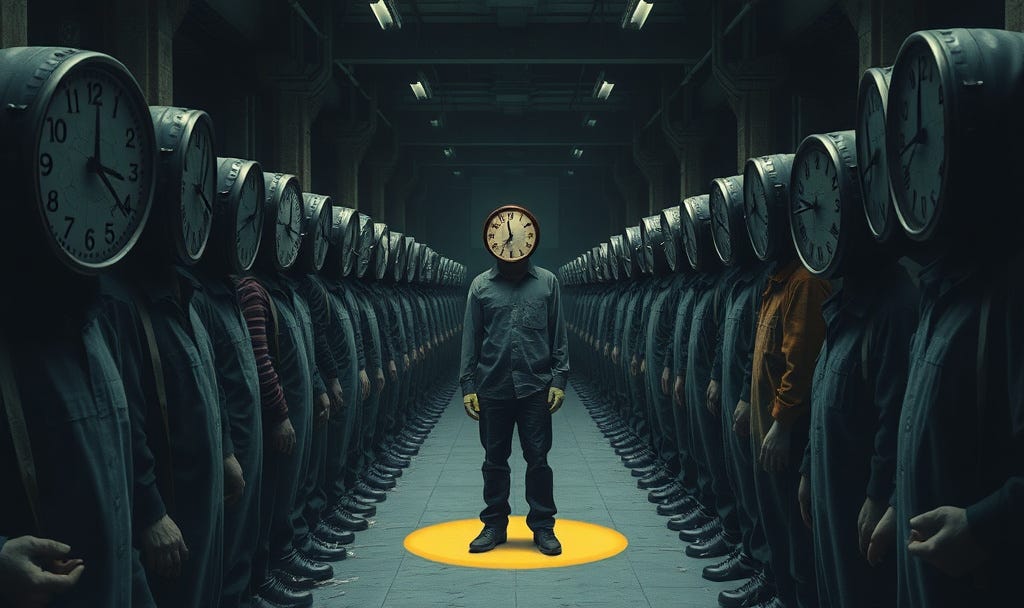
We don’t just work at our jobs anymore.
We build our lives around them.
We structure our days, our energy, even our sense of identity around our roles at work. “What do you do?” is a common means to build connections between people. Yet, we willingly skip children’s plays and miss calls from friends. We eat lunch at our desks and carry stress home like a second backpack. We cancel plans, worry about taking too much time off, sacrifice sleep, and gut our attention spans, all in service of an arrangement we didn’t consciously choose.
The deal is whispered into us from the beginning:
Play by the rules.
Put in the hours.
Keep your head down.
Work hard, be loyal — and you’ll be safe.
But that deal is fraying.
Many are waking up to just how one-sided it really is today. Not with rage. Not yet. But with a quiet, hollow realization that something essential has been stolen — and we were convinced to hand it over.
Because the truth is, we’ve been trained to believe that our lives — our actual lives — are worth less than the places we work. Or rather, that our job is the key to everything else in life and must be treated with reverence above all else.
We’ve watched as companies draped themselves in the language of family, belonging, and purpose. Meanwhile, that same company willingly guts entire departments in order to hit a quarterly target. We’ve seen workers punished for doing what was right but not what was approved. We’ve felt it — in our bodies, in our bank accounts, and in the unspoken grief that something sacred has been lost.
We are not angry because we were asked to work.
We’re angry because we kept our end of the deal — and the system didn’t.
That’s the betrayal.
That’s the reason the stress won’t leave your chest at night.
That’s the reason your eyes glaze over during another “all hands” meeting where nothing human is ever said.
That’s the reason you flinch when someone calls your workplace a “family” — because you’ve seen what happens to families when profits fall.
And yet here we are. Still showing up. Still giving it everything.
Because the system is built to keep us grateful for scraps and terrified of change.
This is not a manifesto. It’s a wake-up call.
The deal is rigged.
And you deserve to know how — and why — before you sign away any more of your one and only life.
The Metrics We Watch
We didn’t just sign up for a job.
We signed up for a system that defines value in only one direction: what can be seen, measured, reported, and monetized.
Because once you step into the machine, the scoreboard changes.
It’s not about meaning.
It’s about metrics.
Every week, leaders huddle around dashboards filled with numbers: orders shipped, labor efficiency, uptime, customer calls answered, attendance percentages. These are observable metrics — neat, quantifiable slices of performance, praised for their objectivity and weaponized for accountability.
But what these dashboards leave out — what they can never capture — are the metrics that actually shape your life:
The parent who misses bedtime five nights a week
The stress headache that starts Sunday night
The creeping fear that you’ll be laid off in the next reorg
The resentment from knowing you gave everything and got discarded anyway
These are hidden metrics — invisible but foundational to the human experience.
And somewhere along the way, we made a bad trade.
We started sacrificing the hidden for the observable.
We gave up well-being for optics.
We surrendered dignity for dashboards.
Let’s talk about what that costs us. And why it’s time to stop pretending the trade is fair.
The Big Shift
Author Bruce Feiler calls it “the nonlinear life” — the reality that life doesn’t unfold in straight lines. People go through transitions, lifequakes, and periods of profound change. What defines the quality of our lives isn’t just how we perform, but how we adapt, connect, and recover.
We’ve built systems that ignore that truth.
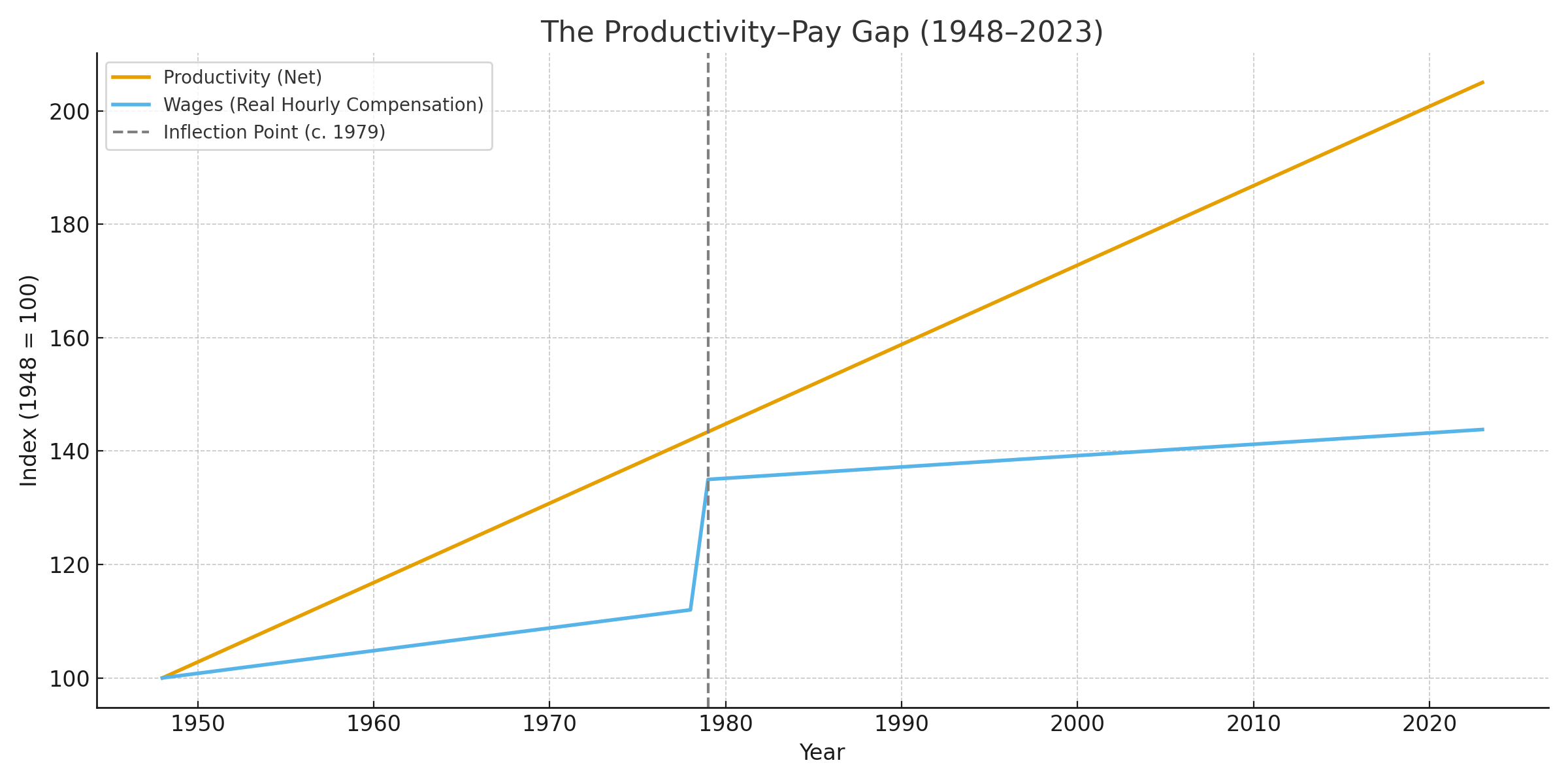
Beginning in the 1970s, wages and productivity started to diverge. For decades prior, as workers became more productive, they were paid more. It was a social contract. But then things changed. From 1979 to today, productivity grew nearly 3.5x faster than wages. Productivity kept climbing. Wages flatlined. The wealth went somewhere — just not to the people who made it.
What filled the gap? Narratives. Incentive programs. Cultural carrots. The promise that work could be family. That fulfillment was a ping-pong table away. That pay wasn’t just compensation — it was validation.
And many of us bought in.
What We Gave Up
We started swapping hidden metrics for observable ones. We accepted that sleep didn’t matter as long as we hit the number. That missing dinner was worth the promotion. That being good at our jobs mattered more than being well.
Companies, in turn, stopped caring and merely shifted to pretending they care. A site could be fully green on its dashboards — KPIs met, shipments on time, labor hours optimized — and still be a toxic, morale-killing mess. The observable metrics said success. The hidden metrics screamed dysfunction.
In this system, it doesn’t matter how people feel — only how they perform. That’s the trade. That’s the sin.
A Story I Won’t Forget
At a distribution site years ago, I was present when a hostler left her yard truck running while she went inside the office to get instructions from a supervisor. While she was gone, one of the company’s wealthy owners — a man rarely seen on-site — happened to be in town and walked by the idling yard horse. He climbed into the cab, waited for her to return, and fired her on the spot for leaving the truck idling.
No written policy. No warning. Just a human being erased by power and ego.
The fallout wasn’t just hers. That hostler was critical to daily operations. Other workers scrambled to cover. Supervisors were blindsided. No one could say a word.
This, from a company that called its employees “family.”
It’s not about one boss. That man had bosses too — shareholders, pressures, and incentives. But the system enabled him. It asked for total loyalty from the worker and gave none in return.
The System Isn’t Broken — It Was Built This Way
The moral hazard in modern work is simple:
Companies demand your humanity — your loyalty, your effort, your flexibility — but they reward only what they can measure.
They say, “We’re a family,” but families don’t rank members on performance reviews or lay each other off to make quarterly targets.
They want you to care — deeply — about their mission, their customers, their future.
But when the numbers turn red, they’ll show you the door without a second thought.
And because you need your paycheck, your healthcare, your shot at a raise — you comply.
You show up. You stretch. You stay late.
You ignore the tension in your chest and the way your partner says, “You’re never really here.”
That’s the trap.
You give more than the job is worth — not because you’re weak, but because you’ve been conditioned to think this is how it works.
That if you work hard and stay loyal, something good will happen.
But here’s the truth:
The system is not broken.
It was designed this way — to extract as much value as possible while giving back just enough to keep you compliant.
It is not personal.
It is structural.
And if you don’t name it for what it is, you’ll keep blaming yourself for why it feels so wrong.
You’ll keep betraying your body, your peace, your kids, your sleep — for nothing.
This isn’t a call to burn it down.
It’s a call to stop betraying yourself inside of it.
To reclaim the hidden metrics.
To build a new kind of dignity, one grounded not in deliverables but in discernment.
Because when we stop pretending this deal is fair, we can start choosing something better.
Deming’s Forgotten Wisdom
W. Edwards Deming, the father of modern quality and systems thinking, never wavered on one point:
Respect for people wasn’t a slogan — it was the cornerstone of lasting excellence.
He didn’t believe in managing individuals with fear or praise. He believed most performance problems came from the system, not the worker. Fix the system, and people will thrive. Leave it broken, and even your best will burn out or leave.
“A bad system will beat a good person every time.”
— W. Edwards Deming
Today, we’re watching this happen in real time.
Good people are exhausted. They’re asked to do more with less — less clarity, less support, less humanity. Companies build feedback systems, but not reliable and consistent improvement systems. They chase quarterly targets, but ignore crumbling processes and aging equipment. They talk about culture but punish dissent. They reward metrics and ignore meaning.
And then senior leaders wonder why people stop caring.
We’ve spent years optimizing systems for control — not care. For outputs — not insight. For margin — not meaning.
Deming warned us. We didn’t listen.
But it’s not too late. His legacy isn’t just about Lean tools or process charts. It’s about rebuilding systems where people can think, contribute, and matter.
The fix isn’t just better dashboards. It’s restoring dignity to work — not through perks or slogans, but through honest systems that honor the people inside them.
What We Can Do
Most people will read this and nod.
They’ll feel it in their chest —
the way work eats at them, steals time from their kids, wakes them at 2 a.m., and leaves them hollow on weekends.
And then they’ll say,
“Yeah, but I can’t afford to change.”
That’s exactly what the system counts on.
It counts on you being too tired to question the trade.
Too stressed to plot a new path.
Too financially fragile to take a stand.
But you don’t need to flip the table.
You need to recalculate the deal.
Start with this:
You are not just a worker.
You are a whole person with needs, limits, values, and a soul.
The company will never track the hidden metrics for you.
So you have to do it yourself.
Start small:
Log your energy, not just your hours. When are you most depleted? When do you feel alive?
Track sleep, stress, and joy like performance metrics. They tell you more about your life than your bonus does.
Audit your calendar. Are you prioritizing what matters, or just reacting to what screams the loudest?
Set boundaries like a professional skill. Because they are.
And then—slowly, honestly—ask:
Does this job allow me to be the person I want to be?
Or does it require me to fragment myself to survive?
Years ago, I had to ask myself the same thing.
The role I was in had prestige, influence, all the right optics.
But the deeper truth was that I was being pulled away from who I was —
tasked with protecting a system that quietly punished its people
in order to reward shareholders.
They had deferred maintenance for years, then blamed the operators.
They cut staffing and called it efficiency.
The work no longer matched the values.
So I walked away.
I fired my employer.
I decided I would never again trade peace, presence, and purpose
for a system that demanded everything and gave the minimum back.
I now work like a consultant.
Not in title — in posture.
I offer my expertise, insight, and judgment to places that want it.
And I retain enough distance to never forget:
My worth is not defined by proximity to the machine.
I’m not suggesting everyone can or should do the same.
But I am saying this: You can stop betraying yourself.
Even inside a job you need.
Even within a system that feels rigged.
You can start protecting your hidden metrics.
You can start saying no.
You can build a life that respects the value you bring
and the humanity you carry.
Because if you don’t — if you keep trading your life
for a seat in someone else’s system —
then the risk isn’t just burnout.
It’s something deeper.
“Your worst sin is that you have destroyed and betrayed yourself for nothing.”
— Fyodor Dostoevsky
Don’t let that be your epitaph.
Don’t trade what matters most for what matters easiest to measure.
Reclaim the deal.
Sources & Notes
Bruce Feiler, Life Is in the Transitions, 2020.
W. Edwards Deming, Out of the Crisis, 1982.
Economic Policy Institute: Productivity-Pay Gap, 2023.
Personal field notes, observations, and experience across U.S. operations.
Editor’s Note
This essay is part of an ongoing series about reclaiming dignity, autonomy, and meaning in modern work. It’s written for those who feel the quiet erosion of self inside performance reviews, for the ones who sense something is off but haven’t had the words. This is for you — not the title you hold, but the person you are beneath it.
© 2025 Todd Andrew Owings