


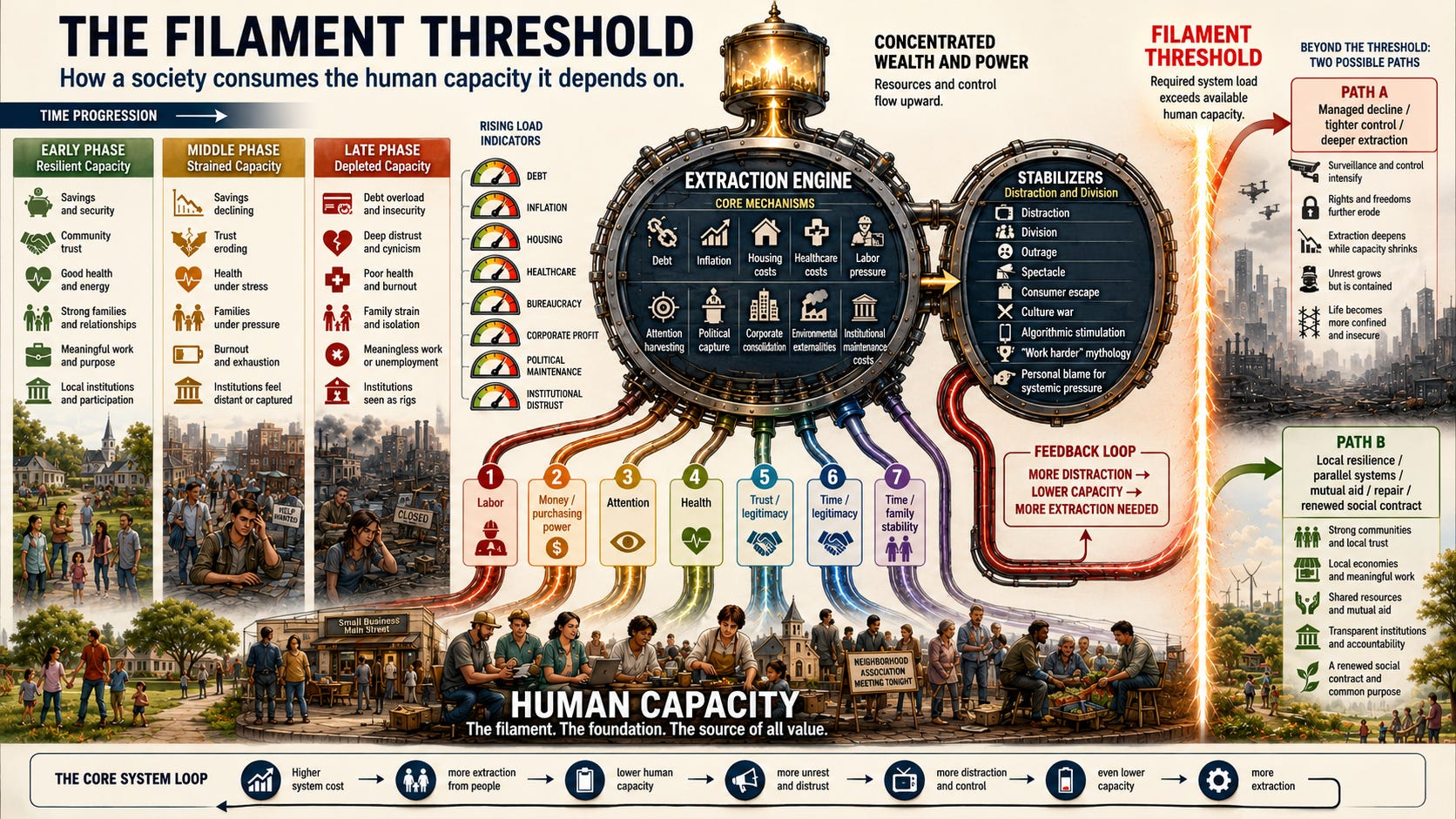
There is a difference between a machine with a broken part and a machine running beyond the capacity of its fuel source.
A broken part is a discreet malfunction. It can be isolated, replaced or repaired and the machine quickly returns to normal state. “Broken” is the state of being often attributed to today’s society. Healthcare is broken. Housing is broken. Politics? Broken. Education, too. The economy and trust in general are broken.
That’s odd. So many broken parts all at once. What if the machine is doing exactly what it was built to do, but the load it now requires exceeds the human capacity available to keep it running normally? That is a different kind of problem.
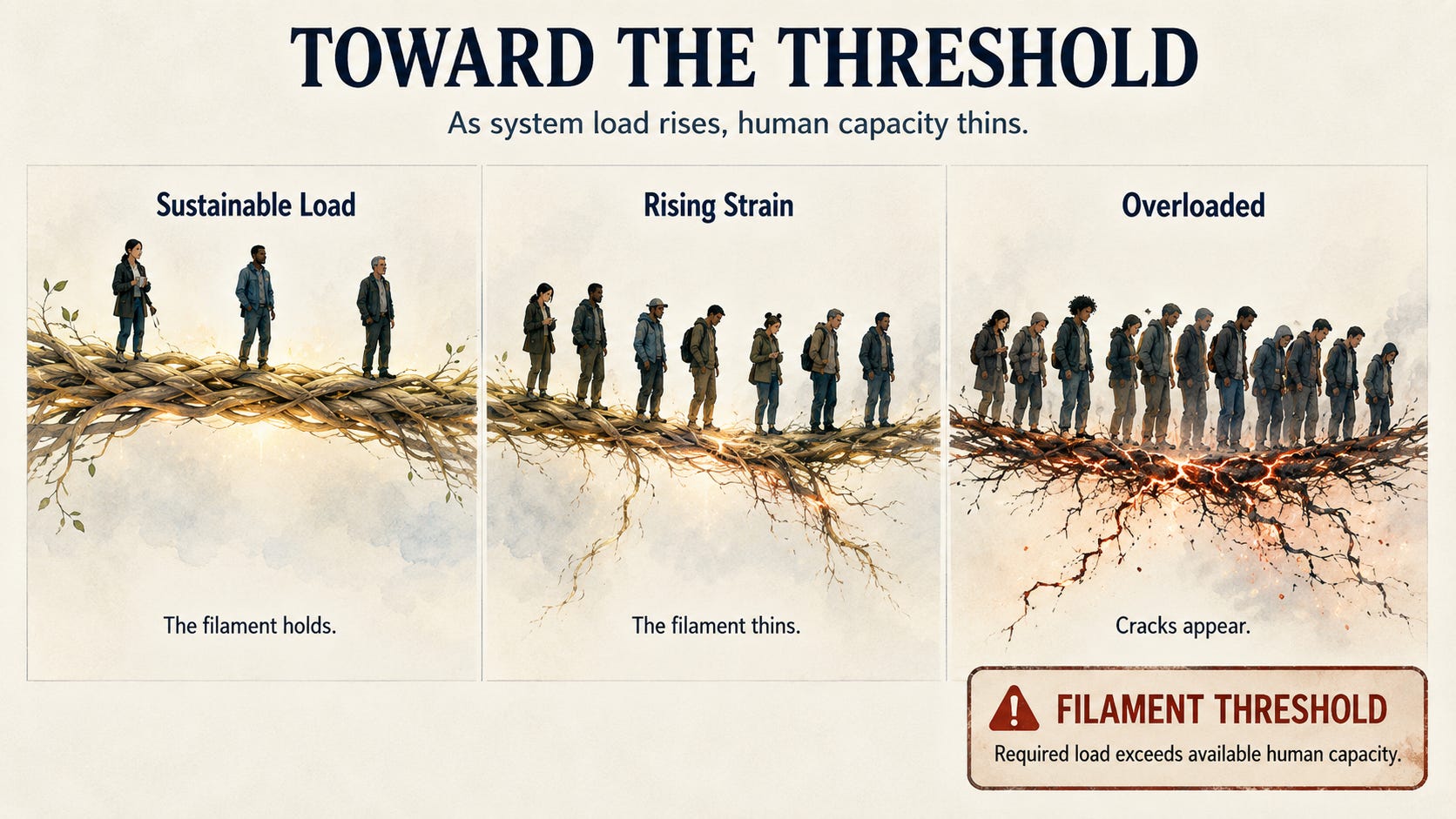
A light bulb does not fail randomly. It fails the exact moment its filament carries too much load for too long. The bulb usually glows right up to moment of failure. From across the room, you may only vaguely notice “something is off” in that moment before the light burns out. Meanwhile inside, the wire is thinning, heating, and approaching failure.
That is the idea behind The Filament Threshold.
The filament is us. You, me, co-workers, families, friends, neighbors. Everybody. Not in a philosophical way, it’s much more mechanical and observable. Societies run on human capacity. Labor. Attention. Trust. Health. That capacity is not infinite and when life keeps demanding more current from the same thinning wire. That the bulb is still glowing is not proof the filament is sustaining.
For a long time, the work-life system drew from our capacity and left us enough behind to recover and build. But over time the cost of maintaining the system keeps rising, the machine demands more current from the same filament.
Debt rises. Housing pressure rises. Healthcare costs rise. Institutional complexity rises. Attention extraction rises. Political management costs rise. The machine does not become lighter but hungrier. It draws harder.
To protect itself during that added draw, the system deploys stabilizers. These are the circuses of distraction, division, outrage, spectacle, and consumer escapism that keep the masses busy not noticing. The mythology of working harder to be successful is deployed, as well.
These stabilizers buy time for the system. They keep people busy, reactive, entertained, and isolated. But they also drain the same human capacity the system depends on. The distraction is not outside the extraction. It’s embedded. That’s the loop.
The system needs more from people, so it extracts more. More extraction brings more strain. More strain creates more unrest and distrust. To prevent destabilization, the system purposely deploys distraction, division, and control. Those stabilizers disperse attention. Then the system must draw even harder for its fuel.
The bulb is still glowing bright, the filament is not fine.
The Filament Threshold is the point where the required load of the system exceeds the human capacity available to carry it. It is not necessarily a single dramatic event. Likely it begins with a slow collective recognition that the the TOS we accepted might not be exactly what we expected.
This is the first piece in a series from Chasing Omniscience exploring that theory.
We will look at the extraction engine, the stabilizers, the role of attention, inflation, debt, burnout, institutional legitimacy, trust, and the possible paths beyond the threshold. The goal is clarity.
Because people can feel the hum of the lightbulb. The work now is to understand what is humming, why it is getting louder, and what it would take to stop burning up the people just to keep the room lit.
-30-
Writer’s Note
The Filament Threshold is my attempt to make a very complex pattern more visible and understandable to people that aren’t economics nerds (like me). This first piece introduces the model, and the series that follows will explore the extraction engine, the stabilizers, attention, debt, burnout, trust, and what might exist beyond the threshold.