


Early in my career, a mentor told me a story that stayed with me. Bringing Lean thinking to his company was his project deliverable, and he was knee-deep in Who-Moved-My-Cheese-style management unwilling and unable to accept any suggestion. No matter the move, red tape slowed his process as fear led to consistently hard pushback.
The system was telling on itself.
Rather than continue an asymmetric battle with site leaders, he reframed his idea around worker safety. The two overlap more than most people realize. When he visited a new site he didn’t begin with charts or presentations. Instead he gathered a few workers and asked them a simple question.
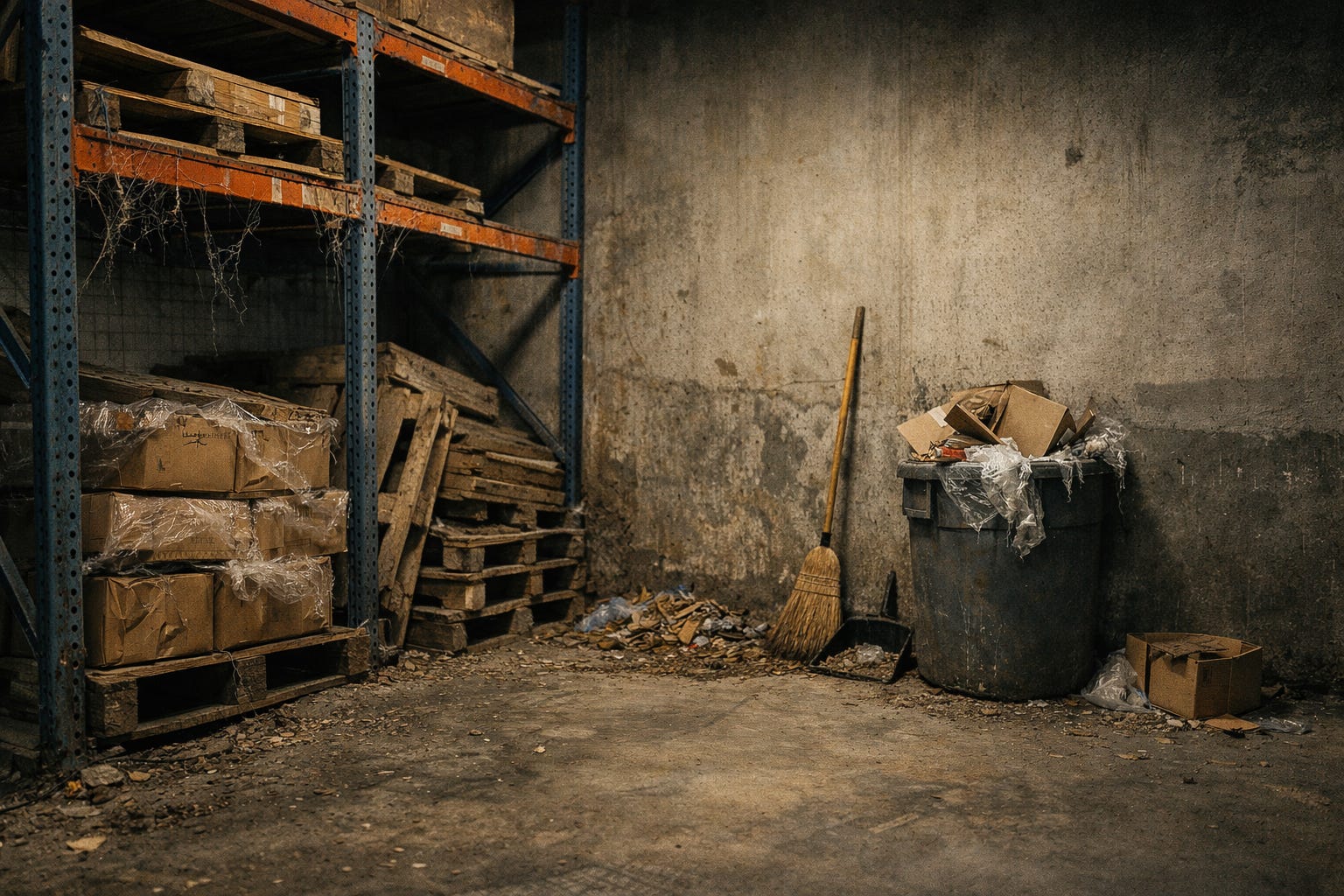
“Please take me to the place in this building that nobody wants to work,” he’d instruct. “Show me the job everyone tries to avoid.” The workers always knew without prompting; they always had a place in mind.
Every building has at least one, usually many more. A corner, a cage, or a rack where problems go to dwell in plain sight. When my mentor walked to that spot the workers suggested, he was almost always standing over a big target.
The idea stayed with me. I don’t usually ask it out loud, but I start looking for the answer the moment I walk into any operation. I was built for this kind of observation, since I see systems in motion in my mind. I notice the flow and when it drags, the hidden friction and sloppy handoffs that occur when nobody owns a process. Years of walking operations has sharpened that instinct, but the core of it is simple curiosity about how work actually moves.
A pallet or many sitting where pallets usually don’t or should not sit, or tools scattered because nobody returned them. Dust caking on flat surfaces in a stuffed but abandoned corner that suggest nobody is really responsible for that space anymore. Areas that quietly absorb labor and attention because the system never fully accounted for their existence in the first place. Each almost always tells the tale of hidden inefficiency or even risk.
These are not housekeeping problems. They are signals. They tell you the operation is being led as a series of individual tasks rather than a complete in-dwell-out system. Strong operations run as systems. Work moves forward with a purpose and preplanned rhythm and cadence. Ownership is clear and problems get corrected before they have time to spread.
Conversely, weak operations slowly become a collection of activities. Each group of workers performs its work and then hands the result to the next group without regard to the dwell, flow, or number of touches. Small disruptions accumulate in the spaces between those activities. Workarounds appear so the day can keep moving. Eventually those workarounds become the process.
The most dangerous part is that the people inside the building stop seeing the drift. What started as temporary becomes normal. The pallet in the corner stops looking strange, and soon more join it. The extra touch in the process starts to feel necessary.
I’ve walked through buildings where operators were working incredibly hard while the system quietly worked against them. None of it showed up clearly in the reports, dashboards or trackers but the building itself told the story.
This is where leadership matters most.
In strong operations leaders stay close to the work. They walk the building. They see the signals early and correct them while the problems still are small. The goal isn’t about cleanliness it’s sustaining operational continuity. When a system loses continuity, flow begins to break down.
What I see more often now is leadership trying to understand operations from a distance. Dashboards and trackers begin to be the source of truth. Meetings form around explaining what the numbers might mean and how to make them turn green. When the explanations don’t settle the conversation, another tracker is added so leadership can stay informed. It feels like control, but it’s just activity.
No action list can replace an understanding of the nature of the system and how it works. Action without understanding is just motion.
Put plainly, you cannot fix what you don’t understand. How it runs, and stops and struggles and flows. That is earned knowledge by those close to the work who look and listen to the real work being done. Dashboards and trackers are a way to manage the conversation about the numbers while the real system continues doing what it is doing.
Meanwhile the building is still there telling the truth.
The corner nobody wants to go to still exists. The signals are still visible to anyone willing to walk the floor and look at the work with fresh eyes.
Operations are physical systems. Work moves through space. When that movement begins to break down, the evidence shows up in the building long before it shows up in the reports. That’s why my mentor’s question still works.
If you want to understand a system, start by asking the people who work there one simple thing.
Where is the place in this building that nobody wants to go?
Start there. The system will tell you the rest.
-30-
Author’s note: I see operations as systems in motion. Flow, breakdown, and recovery show up to me before metrics do. Once you see it that way, it’s hard to walk a building without noticing where the system is telling on itself.