


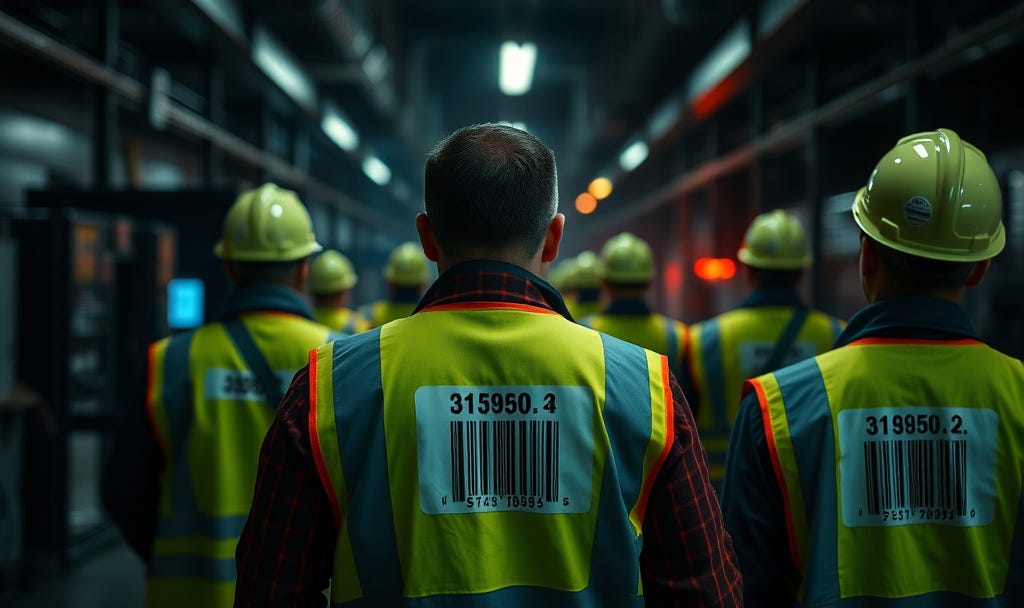
There was a time when leadership was an act of stewardship. The job was simple in principle, even if it was never easy: protect your people, build stability, and earn trust by doing the right thing even when no one was watching.
Responsibility meant something.
Some of the finest leaders appeared stern, even unpopular, but their authority was tethered to responsibility and human decency. There was humility in it — an understanding that the power existed to lift and support others, not to see them as headcount that could be cut whenever expedient.
That ethos disappeared faster than anyone expected.
The Descent
It began innocently enough — the near worship of efficiency, the rise of metrics as a measure of commitment to the company. By the late 1990s, the gospel of shareholder value had fully replaced the language of ownership and responsibility.
Then came the consultants.
They arrived speaking Lean, quoting Toyota, invoking Deming, and selling value stream enlightenment in meeting decks. Ultimately, they ushered in something colder: the ability to use Lean to quantify people more precisely as a measure of throughput.
Private equity noticed. Then, they reverse-engineered Lean.
They saw its elegance: the promise of process visibility, waste elimination, and operational discipline. Then they stripped out the human core — respect for people — and replaced it with advanced analytics, modeling and simulation.
For decades, investors had modeled labor savings in broad strokes. Lean gave them a microscope. Suddenly, every movement, every task, every second of human effort could be observed, measured, quantified, modeled, and monetized in a much more efficient manner.
What had once been a philosophy of empowerment became a precision-guided labor reduction tool. What was meant to make work meaningful was recast as a method for making it cheaper.
“No problem can withstand the assault of sustained thinking.”
Private equity didn’t misunderstand Lean; they perfected its extraction potential.
The result wasn’t transformation. It was optimization without empathy — an economic Darwinism masquerading as science.
Voltaire once said, “No problem can withstand the assault of sustained thinking.”
He was right. But we’ve built a system where all that thinking is aimed not at solving problems — only at squeezing more value from the people still doing the work.
The Conversion of Fear
This new model needed a fuel source, and it found one: fear.
Fear of missing a number.
Fear of losing the client.
Fear of being labeled “resistant to change.”
It’s a remarkably efficient energy. It requires no inspiration, no loyalty, no shared purpose. Just pressure, targets, and the steady implication that everyone is replaceable.
Executives feel it from shareholders.
Directors feel it from executives.
Supervisors feel it from directors.
And the people actually doing the work — the ones lifting, driving, building — absorb it silently, like an airburst of radiation from above.
The fear changes people. It rewires behavior. It makes reasonable leaders transactional, and once-honorable ones often petty and cruel.
They start to equate their survival with obedience.
They stop challenging absurd expectations.
They stop defending their people.
They stop leading.
The Disconnection
This is the real legacy of the private equity era: a structural disconnection between decision and consequence.
Senior leaders don’t see the human cost of their directives anymore. They see dashboards and models — sterile instruments that turn frustration, fatigue, and injury into trend lines and bar charts.
“Farming looks mighty easy when your plow is a pencil and you’re a thousand miles from the cornfield.”
The farther they get from the floor, the easier it becomes to confuse abstraction with real, authentic insight. Dwight D. Eisenhower once said, “Farming looks mighty easy when your plow is a pencil and you’re a thousand miles from the cornfield.” The modern executive plows with data and wonders, without irony, why their plans don’t meet specifications in an actual operational environment.
They talk about “our people” as if they’re an audience, not a responsibility.
They use the word team while dismantling the conditions that make teamwork possible. They repeat the language of Lean while violating its first principle — respect for people — in nearly every decision they make.
It’s not malice; it’s detachment.
A slow decay of empathy replaced by metrics and incentives.
The Corporate Ethic of Cowardice
Modern leadership has become a closed-loop system of fear and reward. Executives make cuts they know are destructive because it pleases investors. They announce them with language so polished it feels almost humane — “right-sizing,” “optimization,” “strategic transformation.”
In the middle, cowardice masquerades as doing-our-best pragmatism.
Managers explain away the perceived cruelty with a shrug — “It’s above my pay grade.” “I don’t make the rules.”
And on the floor, the people who actually hold the company together are told they’re part of a “family,” complete with monthly meetings meant to foster unity.
But they see the truth — that what was once trust has become theater, and that real families don’t need to be convinced they belong.
There’s no accountability anymore — only performance.
A hierarchy of self-preservation.
The Amazon Example
Consider the most visible case: Amazon’s October 2025 announcement of 14,000 corporate layoffs, potentially doubling in early 2026.
The company described the decision as a move to “reduce bureaucracy” and “become leaner in the era of AI.” Yet internal communications admitted the cuts came “despite the company’s performance” beating market estimates handily.
That single phrase captures the ethos of the age.
Success no longer protects anyone.
Profit is no longer the reward for excellence; it’s the justification for elimination.
This isn’t innovation. It’s institutional cowardice — fear of investor dissatisfaction disguised as strategy that belies the growth of real value over time in an operation.
And it’s not unique to Amazon. Every industry has its own smaller, quieter version.
The system has simply learned to make cruelty look like economic sacrifice for the greater good of the company.
The Moral Decline
The speed of this collapse still shocks me.
It didn’t take a generation to lose our moral bearings; it took a business cycle.
Once the language of stewardship was replaced with the language of extraction, everything else followed in short order.
Respect for workers gave way to performance management.
Loyalty gave way to accountability.
Trust gave way to compliance.
And humility — the essential trait of every great leader I ever knew — is a rare and valuable find in today’s workplaces.
Leaders no longer admit uncertainty.
They don’t ask questions; they issue talking points.
They don’t walk the floor; they schedule town halls
They’ve learned to mistake visibility for leadership.
They no longer see themselves as part of a continuum — inheriting something worth preserving and handing it off better than they found it.
They see themselves as interchangeable actors in a performance of competence, judged only by what the quarter says when the curtain falls.
The Red Line
There comes a point when all the euphemisms stop working.
If you lead people, you know this moment — when you’re asked to do something that crosses your own moral threshold. When your gut tells you the spreadsheet is lying. When you realize that protecting the business and protecting the people who make it possible are no longer the same thing.
That’s the red line for me.
Most cross it quietly, telling themselves it’s temporary.
But every compromise makes the next one easier.
Leaders once defined themselves by the burdens they accepted.
Now they define themselves by the risks they avoid.
The Reckoning
Every organization has two structures: one made of steel, and one made of trust.
The steel holds up the building.
The trust holds up the people.
Once that trust breaks, collapse is inevitable — slow at first, then sudden.
We’re living in that slow phase now.
The dashboards still glow green. The numbers still please.
But the trust is gone.
Listen closely, beneath the hum of normalcy — you can hear it.
The faint groan of a structure sagging under the weight of its own contradictions.
Leaders built this system.
They can rebuild it.
But not with slogans, not with governance frameworks, and not with another “alignment huddle.”
We’ve had a generation of those — pizza parties posing as gratitude, town halls sold as transparency, off-sites choreographed to look like connection.
They don’t build trust; they anesthetize it.
You don’t rebuild trust with frameworks.
You rebuild it when a leader finally looks in the mirror and admits they’ve been hiding behind one.
It takes humility. It takes personal responsibility. And it takes the courage to say, enough — not as a slogan, but as an act of freedom.
Because the system isn’t broken.
It’s working as designed.
And that’s exactly the problem.
Sources
Reuters – “Amazon to Lay Off About 14,000 Corporate Roles in 2025,” October 28, 2025.
Business Insider – “Amazon Cuts 14,000 Jobs Despite Strong Performance,” October 2025.
CNBC – “Jassy: We Will Need Fewer People Doing Some of the Jobs That Are Being Done Today,” June 2025.
W. Edwards Deming, Out of the Crisis, 1982.
Editor’s Note
This essay continues my series on moral leadership and cultural decay in operations — a companion to The 5S Fallacy and The Death Cult of Operational Dashboards.
It’s written for those who still remember when leadership meant stewardship, when humility was a strength, and when being a boss meant being accountable — not afraid.