



There was a moment I didn’t understand at the time.
We had just enough money. Not enough to relax or feel safe—just enough to get by. Then the brakes went out on one of the cars.
I remember standing there, doing the math in my head, and the first feeling wasn’t panic.
It was shame.
That detail matters, because the shame didn’t belong to the car, the timing of the emergency, or even the math. It landed squarely on me.
Somewhere deep inside, a voice said, “You failed.”
At the time, that didn’t make sense.
I was working hard. I was educated. I was married. I was in a real career. I was doing exactly what responsible adults are told to do.
And still, one ordinary, predictable expense was enough to make me feel weak, dependent, and exposed.
That wasn’t bad luck.
That was the system doing exactly what it was designed to do.
For decades, worker productivity rose while wages didn’t. Costs didn’t pause. Housing, healthcare, education, and transportation all kept climbing.
What disappeared wasn’t your effort, intelligence, or work ethic. Those were never the problem. In fact, entire systems exist to ensure you keep giving those—consistently, reliably, and at full intensity. That’s part of the bargain.
What disappeared from your life was margin.
Your margin.
The extra financial breathing room you once had was identified as excess. The system decided it was paying you too much of it, and then quietly took it back—slowly, methodically, and without ceremony. It was optimized away from you and redeployed where it produced a higher return for itself.
To you, it wasn’t just money.
It was your buffer.
Your sense of safety.
Your ability to absorb life without feeling like one bad week could undo you.
That’s what the system removed. And once it did, you quietly assumed more of the financial risk of living. The pressure didn’t disappear. It simply became all yours.
This is the part that matters most.
People don’t break under this pressure because they are weak or careless. They break because they are trying to live like adults inside a system that no longer budgets for adulthood.
The old bargain included margin. There was room for error, illness, care, and the occasional bad week without it becoming an existential threat.
That margin wasn’t generosity. It was realism—an acknowledgment that you are human, with needs beyond what you produce.
That deal has changed.
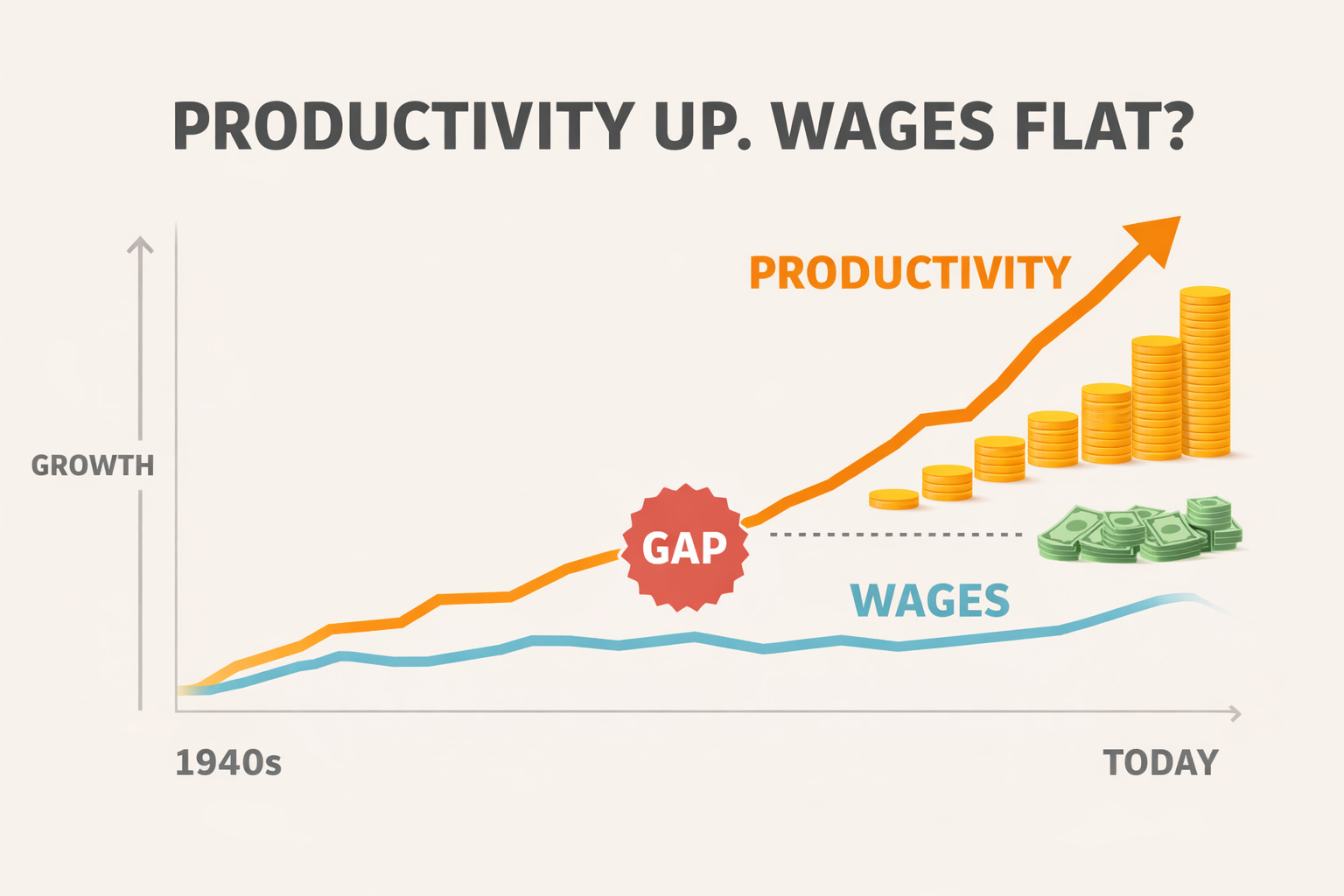
The system didn’t simply tighten budgets or respond to market forces. It rewrote the terms while pretending nothing had changed. Pressure increased. Risk was shifted. Margin disappeared. Responsibility expanded. Authority and compensation did not.
That is an ethical failure.
Any system that increases the burden of participation owes honesty and protection in return. Shifting pressure without consent or compensation is not efficiency. It is exploitation.
This wasn’t done blindly. It was done with models that showed exactly where the pressure would land. The system knew families would absorb it. That workers would stretch. That people would stay quiet. And it proceeded anyway.
Pressure didn’t disappear. It was reassigned.
And pressure does not reliably make people stronger.
It makes them quieter. More cautious. More compliant.
That silence is not consent. It is the predictable result of a system that has decided human stability is expendable so long as performance continues.
Once you see that clearly, neutrality is no longer an option. Silence stops being professionalism. It becomes participation.
This is why certain behaviors become so common.
When you see people pulling back from speaking up, or you notice judgment fade as someone looks the other way, understand what you are observing. You are not witnessing disengagement, it’s the force of pressure.
Pressure created by living inside a system that only functions if nothing goes wrong, and quietly penalizes anyone who introduces uncertainty, friction, or risk back into the process.
When good people stop raising concerns early, when issues are delayed or softened, and when everything appears stable right up until it suddenly isn’t, that pattern is not accidental.
It is adaptive.
People learn that telling the truth early carries a cost, and that being silent is often safer than being correct at the wrong moment. Judgment doesn’t disappear because people stop caring. It disappears because caring without protection becomes dangerous.
So people manage their exposure. They conserve what little margin they have left. They learn when to speak, when to soften, and when to look the other way.
Not because they lack integrity or courage, but because the system has made it unmistakably clear where risk is assigned—and it is no longer absorbed upstream.
In that environment, people are not failing.
They are adapting. They are doing exactly what the system has trained them to do.
This is the moment where you decide what kind of adult you are going to be inside it.
Not a hero.
Not a martyr.
Not someone who burns their life down on principle.
An adult who sees clearly.
If you run a process, you are responsible for where the risk goes. If it has been pushed downward or outward onto people with no authority to refuse it, don’t call that efficiency. Own the decision. Humanize the process.
If you manage people, pay attention to what they are absorbing on your behalf. Every unplanned hour, every softened truth, every unspoken concern is being carried somewhere—often in their bodies, their families, and their sleep.
And if you are being asked to carry weight without power, stop normalizing it. That arrangement is not professionalism. It is risk transfer. Pretending otherwise is how harm becomes routine.
You don’t have to fix the entire system. But you do owe it to yourself to stop participating in the lie that this is neutral or unavoidable.
Seeing clearly comes with responsibility. Noblesse oblige. Once you recognize where the risk is placed, you are accountable for what you do next.
Once you really see it, you can no longer confuse shame with truth. It changes how you stand in the world, the choices that you make, and even how well you sleep at night.
This isn’t about opting out.
It’s about opting back in—with your eyes wide open, your dignity intact, and your humanity no longer treated as an error term.
That’s where this begins.
Writer’s Note
This isn’t theory. It’s lived experience, translated into clarity.
I wrote this for people who feel something is off but have been taught to doubt their intuition. For people who are quietly carrying more than they are allowed to name. For people whose competence has been used against them.
If this landed for you, trust that recognition. That feeling isn’t cynicism.
It’s orientation.
And orientation is where real agency starts.