


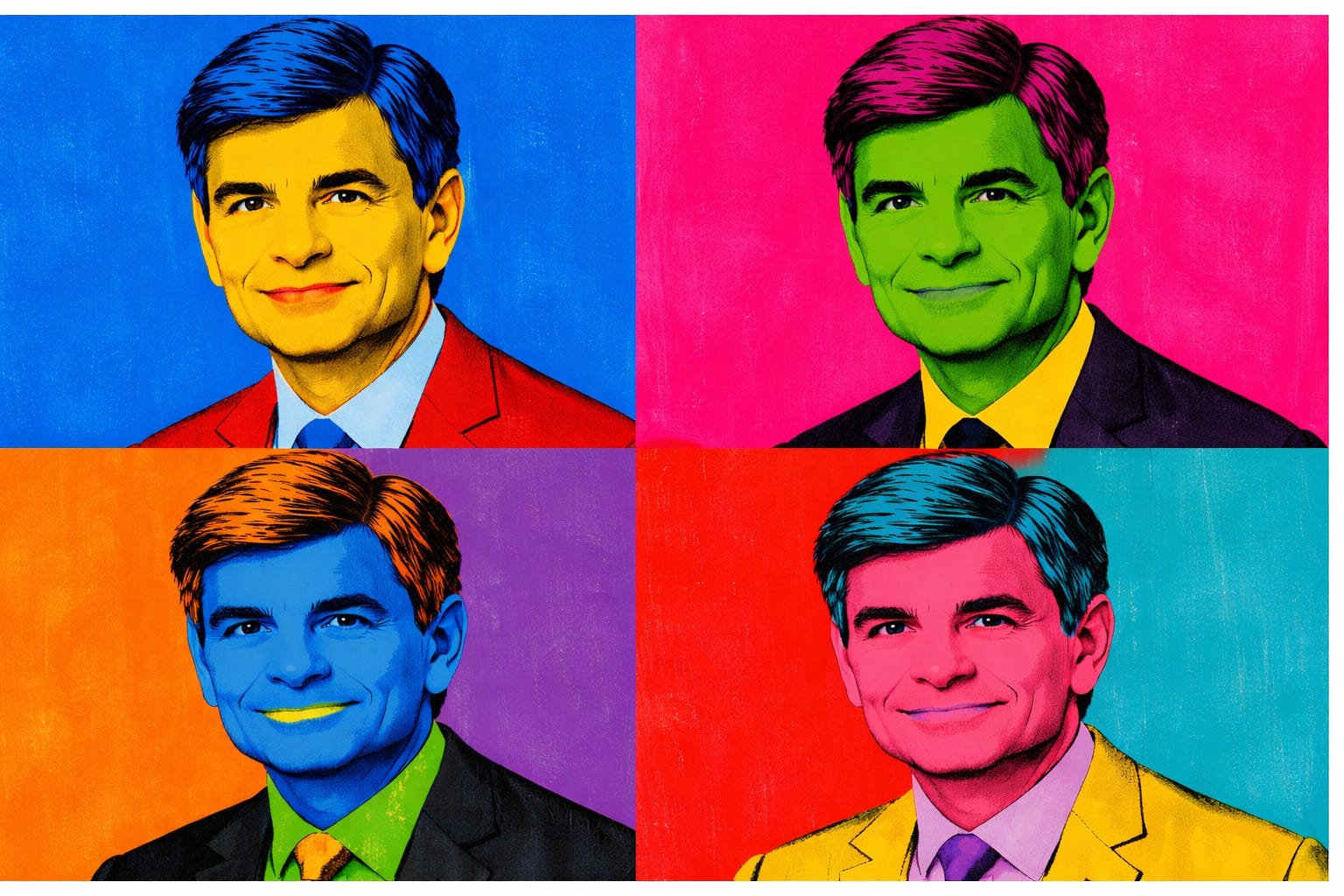
There’s a type of dishonesty that isn’t an outright lie. It relies on the disingenuous use of tone, timing, and reputation to guide reasoning and point toward a preferred conclusion without ever having to defend it.
That dishonesty is destroying journalism from within. Worse, it’s being carried out by people who know better and do it anyway because it serves them. It’s epistemic laundering, using the authority of journalism to enforce orthodoxy while pretending to arbitrate truth.
George Stephanopoulos is not an incidental practitioner of this form. He is its exemplar.
He speaks with the cadence of seriousness, invokes the norms of journalism, and then quietly uses that authority to shut down inquiry when inquiry becomes inconvenient within his worldview. Nothing overt, just enough effort to guide the audience away while maintaining the appearance that a question was addressed.
It’s journalism used as a mask for partisan behavior.
The reason this is difficult to call out is that it rarely announces itself as advocacy. It presents as professionalism and counterbalance. It’s often most visible during transitions, moments where a claim should be tested and instead is neutralized. Once you see the move, you notice it everywhere. It isn’t accidental. It’s an editorial posture, dishonestly wrapped in journalistic integrity.
Epistemic Laundering
Using the authority of trusted institutions to pass off partisan enforcement as neutral inquiry, thereby short-circuiting critical thinking without overt deception.
A single exchange on This Week this past Sunday was among the most intellectually absurd moments I’ve seen in modern political journalism.
Marco Rubio was talking about Venezuela. Among the reasons the administration chose not to brief congressional leaders before the operation, Rubio said, was fear of leaks compromising the safety of the soldiers involved.
Stephanopoulos, bristling at the implication that leaks are a real risk in Washington, responded with an unusually clumsy retort before moving on:
“The congressional Gang of Eight has a history of not leaking.”
Wait. What?
Stephanopoulos didn’t test Rubio’s claim. He substituted reputation for inquiry.
The argument, reduced to its logic, is that the Gang of Eight has a history of not leaking, therefore a leak is not a realistic fear. That reasoning is meaningless. The same group also has a history of refilling the copy machine paper when it empties and not leaving used Keurig capsules in the machine after use. None of that tells you anything about access, incentives, changed circumstances, or how a leak would even be detected if it occurred.
The comment tells you nothing. It carries a quiet contempt for the viewer’s capacity to reason through the problem themselves.
I’m not reflexively cynical about the media. I understand its ambitions and its limits. But when intellectual honesty and consistency are replaced with appeals to trust, it stops feeling like journalism and starts feeling like something we’re being asked to accept without question. It begins to feel like we’re living in a simulation.
What I see now, repeatedly, is journalists who have quietly stopped asking the next question. Instead of testing claims, they call on viewers to grant unearned trust. Phrases like there’s no evidence are no longer openings for inquiry; they’re endpoints. This isn’t sloppiness. It’s an intellectually dishonest choice that demonstrates contempt for the craft itself.
The mechanism is simple and effective. Journalistic credibility and institutional legitimacy reinforce one another, forming a closed loop of protection. Challenging anything inside that loop requires overcoming both the claim and the authority dismissing it. Worse, simply asking the question is often treated as evidence of bad faith by the questioner.
The journalist doesn’t need to argue or investigate in this scenario. They only need to signal that the question itself is beneath serious consideration. Most people don’t reason analytically in real time; they reason socially. Tone, confidence, and familiarity do the work. When a trusted voice calmly implies a claim is unreasonable, the audience understands the cue and moves on.
That’s why this works.
Any competent journalist understands that absence of proof is not proof of absence. They were trained in this and built careers on it. When those standards disappear, it isn’t ignorance. It’s a choice to manage perception rather than pursue truth.
A free press doesn’t exist to make people feel safe. It exists to make those in power uneasy. To ask the question that threatens the story is the job of the journalist. Societies ambiguous on that fact, don’t collapse in flames right away. But they do grow less free.
Author’s Note
I think about systems for a living. Systems fail not because of malice, but because incentives drift, feedback loops close, and people learn—often unconsciously—what is rewarded and what is punished.
When a system stops tolerating honest friction, it harms people. It teaches them not to trust their perception, not to speak plainly, not to ask questions. Over time, it trains them out of freedom.
#FreePress #Journalism #MediaEthics #IntellectualHonesty #CriticalThinking #EpistemicLaundering #MediaCriticism #PressAccountability #SystemsThinking