


Most leaders think a warehouse receives product.
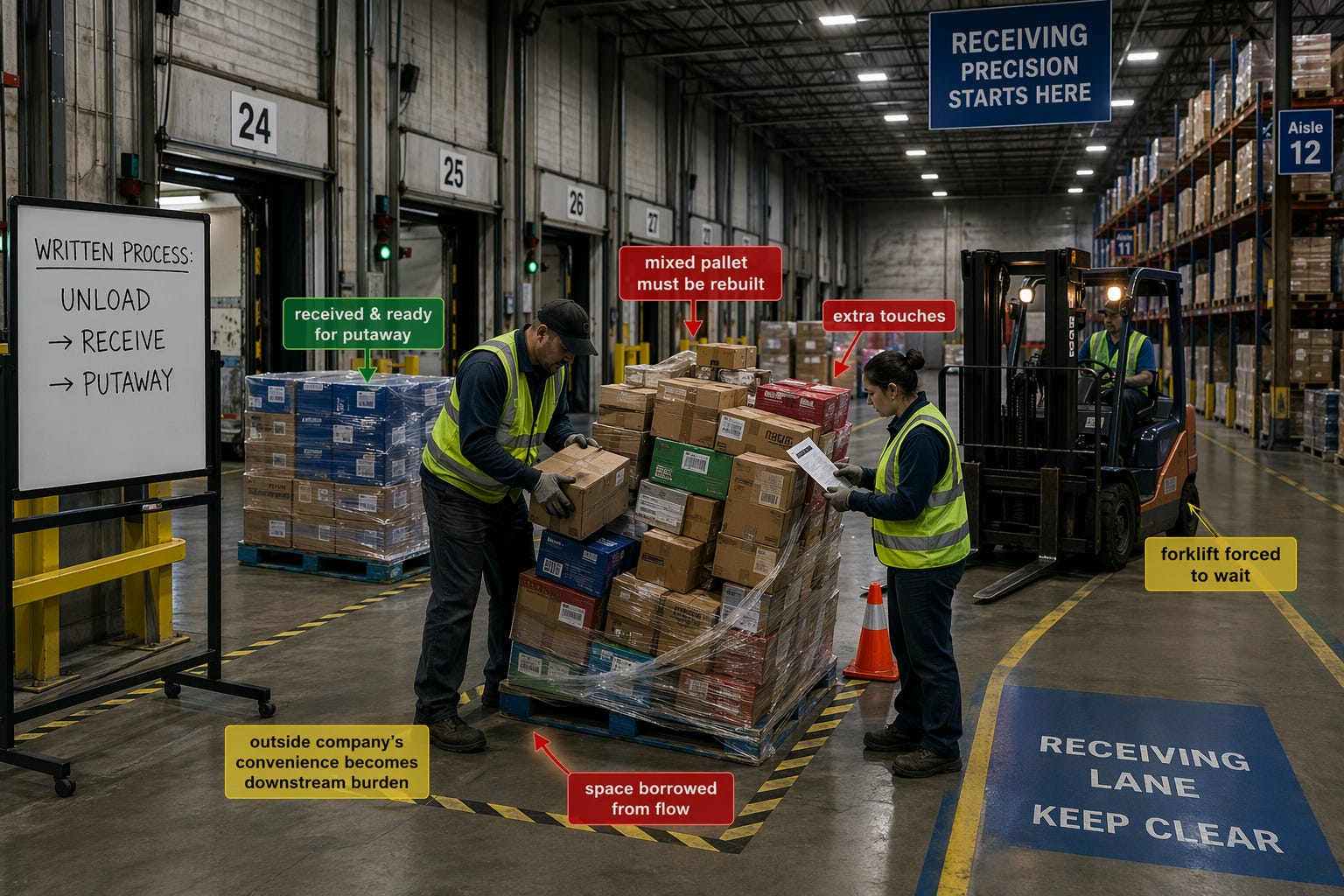
That’s true in the most superficial sense. Trucks do arrive. Trailer doors are opened and pallets are unloaded. Receivers receive. Putaway puts away. If you sketch the process on a whiteboard, it looks like clean and organized: Unload, Receive, Putaway. A neat sequence of control.
But that is not what I see when I stand on a dock. I witness the exact moment where burden changes hands.
When a pallet comes off a truck, for a brief second, the written process works. Then the real system introduces itself quietly. Mixed SKU pallets land, and instead of flowing forward, they stall. A worker must rework it, to make the next process possible. Cases are downstacked to a seperate pallet. Weight gets shifted. Layers get examined. The pallet that was supposed to be moving now has to be translated by hand into something the building can tolerate.
That moment matters in ways dashboards cannot typically illuminate.
It reveals a failure by someone in the supply chain to satisfy the downstream putaway requirements of one SKU/one pallet per location in a warehouse. In order for a mixed SKU pallet or floor loaded freight to work here, it must be stable enough to travel safely, sorted enough to separate by SKU, identified clearly enough to be received accurately, and built in a form the putaway and replenishment process can actually absorb. If it arrives built in a way that violates those downstream requirements, the missing work cannot be avoided. Someone on the dock must convert it by hand into something the building can use. That is why the work appears there. The requirement never went away. It simply arrived on the inbound dock and became manual labor.
That is the kind of activity most leaders never really see.
They see activity and people working. They see forklifts and receivers moving and assume the operation is functioning. But a warehouse can lie to you all day long if you do not know how to see what is really happening. Motion is not the same as flow. A team can be working heroically while the system quietly steals life from them one adjustment at a time.
The written process almost never tells you this.
That process assumes readiness. It assumes that what arrives can enter the building’s flow more or less as is. It assumes that what is coming into the facility meets the condition the downstream process can absorb. But that assumption is wrong more often than leaders realize.
Shippers optimize for their own realities centered around cost, cube and trailer utilization. Loads are build for order profiles, labor convenience, local workarounds, or whatever pressure their shipping department is under that day. The freight arrives at the downstream facility in a condition that violates what the receiving and putaway system actually requires.
At that point, the requirement does not vanish. It cannot vanish. The pallet still has to become something the building can store. If it cannot do that in the condition it arrived in, then a local worker must do the missing work. Not because anyone chose it. Because the system leaves no alternative.
That is the hidden theft.
One part of the network gets the convenience and savings. Another part gets the burden and cost. And when that burden lands on the dock, it spreads fast.
A pallet that should flow now becomes WIP until a receiver, who should be verifying, now must rebuild. Space that was supposed to support movement now has to absorb correction work. A forklift path tightens. A staging area starts to do the work it isn’t funded to do. The whole facility begins paying, in real time, for an upstream decision it did not make and cannot refuse.
This moment is a transfer of burden across organizations.
Freight that does not arrive in a form the building can process occurs when an upstream actors fails to satisfy that requirement. The burden slides downhill until it reaches the point where physical reality forces honesty. That point is often the dock. The dock is where abstract decisions translate into one company’s convenience becomes another company’s labor.
That is why I stand there.
I am not standing there to admire activity, rather to observe where the written process loses contact with physical reality. I am standing there to find the hidden constraints that create dwell and cost long before anyone has language for them. I am standing there to see the points where the system is being quietly asked to do work it was never designed to do.
That work is often invisible to the untrained eye precisely because it does not announce itself dramatically. There is usually no siren, it just quietly happens and hidden costs accrue.
A little more attention here or a second touch there. A pallet set down “for now” in a place that was meant to stay open. A receiver shifting from formal work to translation work. A lift driver negotiating with the aisle instead of moving cleanly through it. A building that still appears to function, but now functions like a body carrying tension everywhere.
That is the cost.
Not just labor. Not just time. Not just dwell.
Burden.
Burden dropped into the system one pallet at a time until the whole operation starts compensating in ways that no standard work document ever mentions.
This is why I have become so sensitive to hidden constraints. I know the written SOP is never the whole story. The real story is in the conditions required to make that path possible. If those conditions are absent, the missing pieces do not stay abstract. They are supplied manually by the people inside the system. The warehouse becomes the translator of other people’s unfinished work.
And once you learn to see that, you start seeing much more than a receiving issue.
What looked like a bad pallet becomes an upstream design failure. What looked like a local delay becomes a cross-company burden transfer. What looked like “the team handled it” becomes “the team absorbed a cost leadership never saw.”
That last one matters.
Because there is a moral dimension to this. Moral in the sense that systems can be arranged in ways that place unnecessary burden on human beings and then normalize it so thoroughly that no one even thinks to question it. A person spends part of their day compensating for distortion that never should have reached them, and because they are competent and conscientious, the organization calls that normal work.
It is not normal work. It is forced accommodation.
And the more capable the people are, the easier it is for leadership to miss. Good operators can hide enormous design failure simply by absorbing it. They keep things moving. They save the day in small ways, over and over, and the system repays them by making their extra effort invisible.
That is one of the reasons standing still matters so much.
If you move too quickly, all you will see is motion. And motion will lie to you.
If you stand there long enough, though, the pattern is unmistakable. You begin to see which pallets move cleanly and which ones arrive with a debt attached to them. You begin to see where space is being borrowed from flow and where degrees of freedom are being lost. The warehouse is not merely processing freight. It is correcting for upstream realities, often at significant hidden cost.
That kind of seeing is not automatic.
It takes a skilled set of eyes to see it clearly.
It takes someone who can hold the written process in one hand and the physical truth of the building in the other, and feel the gap between them. It takes someone who can watch a pallet and understand not only what is happening to it, but what had to be true for it to flow cleanly, what is missing, where that missing condition is now being supplied by hand, and how the cost of that burden will propagate outward through the facility. It takes someone who can look at a dock and see not just work, but the invisible negotiations the system is demanding from people every minute.
That is what I do.
I stand at the seam where burden changes hands, and I make that transfer visible.
I can see when one part of the network is surviving by forcing another part to compensate. I can see when a pallet arrives carrying hidden labor inside it. I can see when the building has stopped flowing and started negotiating. I can see when the team is doing work the official process never admitted existed. And because I can see it clearly, I can help others see it too.
That clarity matters because once the hidden burden is visible, the conversation changes. You stop blaming the nearest operator and begin asking the better question: what requirement exists downstream that is not being satisfied upstream, and why are we paying for that failure here?
That is the doorway to real improvement.
Not more effort. Not more pressure. Not another speech about accountability.
Truth.
Every once in a while, you remove enough distortion that the building tells you the truth back. That moment is not just operationally satisfying. It is beautiful.
Because what you are seeing is not people working harder. You are seeing unnecessary burden removed. You are seeing right relationship restored. You are seeing a system stop lying about what it requires and begin to move truthfully again.
Most people will never notice that moment for what it is.
I will.
Because seeing hidden burden clearly is a skill.
And it is mine.
-30-
Author’s note: I write longer-form essays at Chasing Omniscience and shorter field observations at Seeing Systems Clearly. If you are interested in hidden drift, burden transfer, and the patterns most systems teach themselves not to see, that is where to find me.