


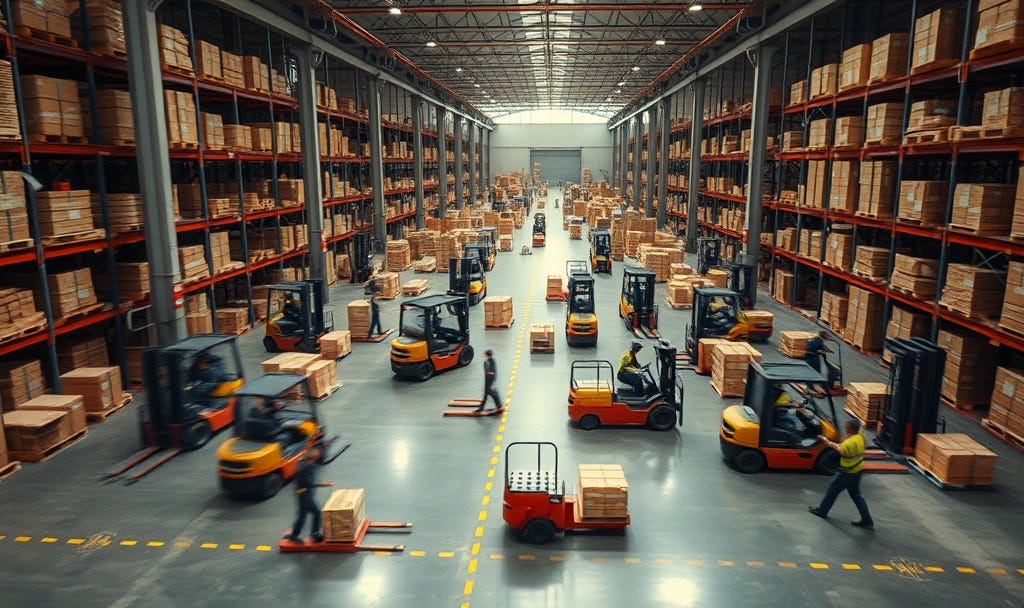
Standing on the inbound dock after unburying an underperforming receiving process, I looked up from my time study to see multiple forklifts moving simultaneously with freedom of navigation. It literally took my breath away, as I witnessed flow in its purest, most beautiful form return to the space.
One of my problems in explaining my work is that most language for continuous improvement belongs to business. Labor hours. Cycle time. Productivity. Throughput. Waste. Rework. I know and use those words because they matter. A company must make profits to exist. A warehouse needs to move product. A process that burns time, space, and motion costs somebody something, even when the cost is hidden in the daily rhythm that looks normal.
That CI language has given me access for most of my career. It gives leaders a reason to allow me near the system. It lets me explain why something matters in terms the business can recognize. When the work starts moving better, savings almost always appear. Sometimes obvious, other times those savings must be excavated out of extra touches, excess travel, hidden rework, or the daily cost of people interpreting a process. I am grateful for the savings that results from my work because it’s real, and because it creates the permission to keep doing the work.
It’s more difficult to explain that the savings is not what makes me come alive. Savings is just the receipt for my work. They prove something valuable happened, and the business is right to care about them. But the thing I am really drawn to is the living motion of the floor itself. That is my artistic medium. A musician works in sound. A sculptor works in stone. I work in motion and patterns. I work in the space between what the process claims to be and what the floor is doing to keep it alive.
I do not experience an operation as a list of tasks, rather a field of relationships in motion. People, equipment, product, space, timing, information, and purpose are all moving together. Sometimes they cooperate. Often, they fight. Sometimes the whole operation is absorbing the cost of a system that has drifted away from its intended shape. Cases still move. Orders still ship. Up close, I see the loss of flow to constraints and ambiguity.
That is usually where my attention goes first. I notice the small places where the next move is not obvious. Or when an experienced operator must make an unnecessary judgment the process should prevent. I notice when space forces equipment into awkward negotiation and product shows up in a form the building cannot cleanly absorb. Those are places where money disappears and human intelligence is spent holding together something broken.
I am different from most who are placed under the same general heading of continuous improvement. Like most, I use the tools, build the case and measure the work. Each is useful, and I do not dismiss them. But I do not begin with the spreadsheet. I begin with the motion. In order to access my gifts of clear seeing, I must witness how the system behaves. I see exactly where the workaround is the process.
A process usually has a truer shape than the one the organization is living with. The work knows, in a practical sense, what it is trying to become, but ambiguity covers it. Workarounds grow around the unclear places. Tribal knowledge fills the gaps. People invent small ways to survive the day: extra checks, local rules, little decisions that never appear in the documented process. Because the work keeps moving, the organization begins mistaking the survival pattern for the process.
That is where I usually start. I am trying to find the original shape underneath everything people added to keep the work moving. The first material I carve away is ambiguity. Unclear versions of sequence, ownership, handoffs and expectation must be chipped away. Ambiguity forces workers to interpret while they are doing, and once that starts, compensation grows around it. Experienced people learn the hidden rules. New people step on the hidden mines. Supervisors spend their day translating exceptions. The system survives by hiding how much of its stability depends on people carrying what the process failed to make clear.
When ambiguity is removed, motion appears first. That is the part I love. The explanation for the improvement may still be incomplete, but the floor starts to move differently. Next, handoffs clean up and the lurching eases. The room finds its pulse. People no longer must burn attention to follow the system, so their attention returns to the work itself.
That is the beginning of flow. Not speed. Not busyness. The first sign is cleaner motion. The work starts taking its proper shape, and the floor begins to show what it had been trying to become all along.
I have seen this happen in both large and small ways. A path opens. A staging point moves. A sequence becomes clearer. The handoff is changed so the next person receives usable work instead of a problem to interpret. The effect can look almost ordinary from a conference room because conference rooms flatten motion. On the floor, the change is like lightning striking. Equipment stops negotiating with space. Workers no longer must pausing to solve the same preventable question. The room can be busy, but also becomes calm.
That is the moment I stop and watch. To someone else, it may look like forklifts, carts, pallets, cases, people, and equipment moving through a building. To me, it looks like a sculpture coming alive. Everyone is moving differently, in different directions, with different tasks and timing, yet the movements belong to a single unspoken purpose. That is the part that brings me joy before I have words for it. The analysis comes later. The savings come later. First the floor moves, and something in me recognizes that the system is more honest.
That is why I compare it to music. When a band locks in, it becomes greater than any individual instrument or performer. You feel it. Each person is still playing a separate part, yet the parts belong together. A warehouse can do that, also. A good floor has a pulse. A great floor finds a groove. When it happens, the room becomes more awake. The energy rises without turning frantic. Possibility returns because the system has stopped spending all of its strength surviving itself.
The operators change in those moments too. Their competence stops being trapped inside rescue. Their intelligence returns to circulation. You see it in timing, coordination, anticipation, and economy of motion. They move at the right moment instead of the urgent moment. They fit into the field around them without forcing the whole room to make space. They start using their knowledge as craft instead of as shock absorption for bad design. That is indescribably beautiful to me because it is precise and purposeful. Every movement has a reason. The work lands exactly where it belongs.
This is also the place where cost savings is present. The company saves money because the floor stops paying hidden taxes. Less wasted motion, rework, searching, and all the other wastes. Workers spend less human intelligence managing ambiguity. The business gets real value because the work is closer to its intended shape. The people inside the process get relief because the system asks less of them in the wrong places and allows more of their actual skill to show up in the right places.
That alignment is the part I care about most. Serving the floor and serving the business can be the same act when the system is restored instead of merely pressured. Many organizations try to pull money out of operations by squeezing the people closest to the work. That creates motion, effort, compliance, and a great deal of hidden compensation. Real flow does something different. It removes what should not have been there, lets the work take a cleaner shape, and allows the savings to appear because the system is no longer wasting itself.
This is what I want a senior leader to understand about me. I am not animated by the performance of continuous improvement nor interested in dressing up obvious observations in corporate language. I am useful because I can stand inside a living system and see where it has become untrue. I can see where the represented process and the real process have separated. I can see where the workaround has become the process.
Then I can usually help remove enough of that burden for the real process to start showing itself again. That is where the money is. That is where the dignity is. That is where the craft is. It is all connected. The same change that saves labor can also release operator competence and restore rhythm. A cleaner handoff reduces friction, increase trust, and makes the work easier to teach. The financial value and the human value are often coming from the same source: the system has stopped forcing people to compensate for what it should have made clear.
That is why I keep returning to the floor. It is the only place where the system tells the absolute truth. A dashboard is useful, but it can also be too clean. The floor has less patience for fiction. It shows where the burden went, where the rhythm broke. It shows when the room is holding its breath. And sometimes, if you remove the right ambiguity and give the work enough room to take its proper shape, it shows you something beautiful.
Being present the moment the floor comes alive. That is the medium I work in. Motion with purpose. Relationship made visible. Sequence becoming clear enough that the next move feels natural. People, equipment, product, space, and timing moving in a way that finally belongs to the work. The savings matter, and I know how to find them. But the reason I do this, the reason I can stay with a system long enough to see what others miss, is because every once in a while the hidden form appears, the room finds its rhythm, and the work shows what it had been trying to become all along.
Moving sculpture.
-30-
Author’s Note
This piece is the companion to The Workaround Became the Process. That essay is about drift. This piece is about the other side of that same reality: what I see when the burden starts to lift.
I have spent most of my career using the language of continuous improvement because it gives organizations a way to understand the value of the work. But that is not what first pulls me to the floor. Motion pulls me in.
I experience a working floor as a living field of relationships and purpose all moving together. When ambiguity is removed and the work takes its proper shape, motion becomes cleaner. The next move becomes obvious. Operators stop using their intelligence to compensate for confusion and begin using it as craft.
That is the part that feels like art to me.
The savings are the receipt. The art is the moment the floor comes alive.
So beautifully conveyed:
...”the living motion of the floor itself. That is my artistic medium. A musician works in sound. A sculptor works in stone. I work in motion and patterns… I stop and watch. To someone else, it may look like forklifts, carts, pallets, cases, people, and equipment moving through a building. To me, it looks like a sculpture coming alive…That is why I compare it to music. When a band locks in, it becomes greater than any individual instrument or performer. You feel it. Each person is still playing a separate part, yet the parts belong together. A warehouse can do that, also. A good floor has a pulse. A great floor finds a groove... ”